


Vaginal dryness may get more attention in discussions of menopause symptoms, but vaginal discharge can change during this chapter of life, too. Perimenopause discharge can fluctuate as hormone levels shift and your menstrual cycles become more irregular leading up to menopause.
So, what does perimenopause discharge look like, and when is it a concern? Below, learn what’s normal and what’s not, plus how a healthcare professional—including a Midi Health clinician—can help treat possible infections or other bothersome symptoms.
If you’re curious about perimenopause discharge, then you’ve lived long enough to know that discharge is normal—but it has a mind of its own. After all, you’ve probably experienced changes in volume and consistency before, whether due to natural fluctuations throughout your menstrual cycle or because you’ve been turned on, gotten pregnant, or dealt with an infection.
Perimenopause is yet another reason that you might notice changes in vaginal discharge. The good news is that most of these changes are hormonal and typically nothing to worry about.
Still, it’s natural to have questions. Below, we’ll cover the various colors and textures you might notice, what causes changes in perimenopause discharge, which changes may be cause for concern, and how a healthcare professional (like a Midi clinician) can help.
- TK
What Is Perimenopause Discharge, and Why Does It Change?
One of estrogen’s many roles in your body is keeping your vaginal tissue healthy and your vaginal microbiome balanced. As estrogen levels shift during perimenopause (the months and years leading up to menopause), your vaginal pH can rise, and the balance of bacteria in your vagina can change. This may affect the amount, consistency, and smell of discharge.
But estrogen doesn’t just steadily decline during this chapter of life. Instead, it can fluctuate quite a bit—and that can cause the amount of discharge you notice to vary, too. Higher estrogen levels, for example, can increase cervical mucus, whereas lower levels can result in less mucus. Progesterone levels fluctuate during perimenopause, too, which can also affect cervical mucus.
Vaginal discharge changes may not get as much attention as other perimenopause symptoms, but they still happen: “Many more patients ask about vaginal dryness,” says Midi physician Rebecca Yee, MD. “A handful of patients do note increased vaginal discharge in early perimenopause, likely due to increased estrogen.”
Increased vaginal discharge in midlife can also be due to causes beyond estrogen fluctuations, including an infection, changes to the vaginal mucosa, or a thinning of the vaginal wall. (More on the various causes below.)
What Does Perimenopause Discharge Look Like When It’s Normal?
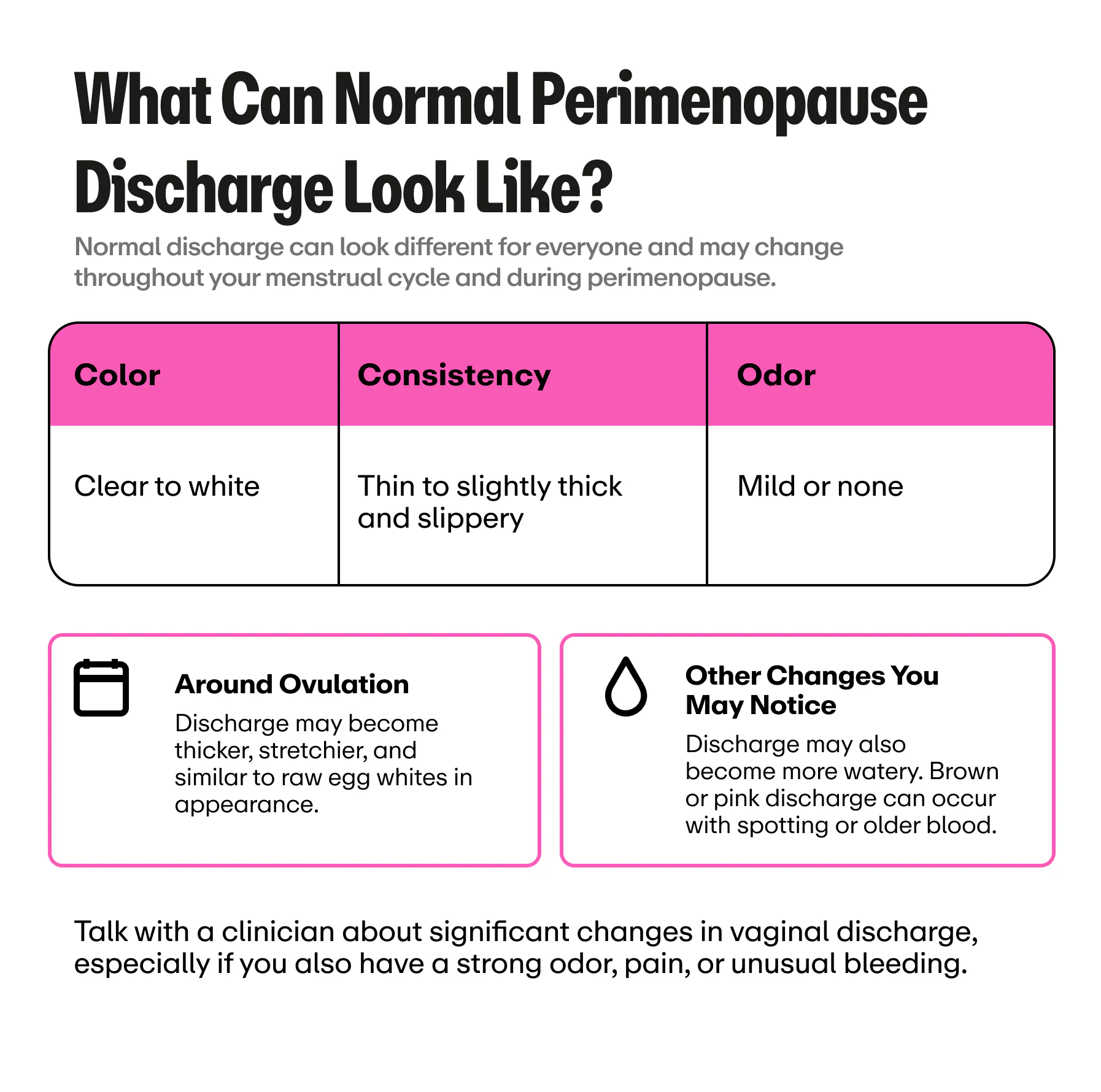
Everyone’s vaginal discharge is different before, during, and after perimenopause. Generally speaking, though, any discharge that’s clear to white, that’s thin to slightly thick, and has a mild or no odor is considered normal.
Discharge is often a bit thicker and stretchier—described as mimicking egg whites—around ovulation in the middle of your menstrual cycle, and you might notice more of it at that time, too. You may still see these changes during perimenopause in cycles when you ovulate.
Other times, you might notice discharge changes from week to week as your cycles become irregular. It may also fluctuate due to factors like diet, sex, and certain medications.
That’s a long way of saying that having perimenopause discharge—even daily—isn’t a problem on its own. What matters more is a significant change from whatever is “normal” for you (more on that below).
Watery Discharge in Perimenopause: Why It Happens
Thin, watery discharge is not unusual in perimenopause as your hormones fluctuate.
Perimenopause watery discharge can be totally normal, but it can also be related to vaginal dryness and atrophy, since estrogen is one of several factors involved in keeping your vaginal tissue healthy, happy, and lubricated.
If you also have burning, irritation, itching, or an urgent need to urinate, you might have what’s called genitourinary syndrome of menopause (GSM)—a collection of vaginal, urinary, and sexual symptoms often related to declining estrogen. Urine leaks can also be more common during the menopause transition, which might be hard to distinguish from watery discharge.
Many women are embarrassed to bring up these changes with a clinician or think they’re simply a part of aging that they’ll have to get used to, but there are treatments that help. So, it’s worth mentioning these symptoms to your clinician, especially if watery discharge comes with painful sex or urinary issues.
You should also talk with your clinician if watery discharge is heavy, persistent, or tinged with blood. (Midi clinicians are trained in perimenopause and women’s health, and they’re here to help.)

Brown Discharge in Perimenopause, Pink Tinges, and Spotting
Brown discharge in perimenopause is typically older blood (newer blood usually looks redder or pink). This doesn’t necessarily mean it’s leftover from your last period; small amounts of blood can take longer to leave your body, giving it time to turn brown.
Hormonal shifts and irregular ovulation can change when and how much you bleed, which sometimes leads to spotting between periods.
Keep in mind that irregular bleeding—including heavier, lighter, longer, or shorter periods—is common in perimenopause. Starting or changing hormonal medications like birth control can also affect bleeding patterns. And because you can still ovulate during perimenopause, spotting might sometimes be related to pregnancy. So talk with a clinician about persistent irregular bleeding or spotting. The same goes for bleeding that is unusually heavy, is prolonged, or happens after sex.
Once you’ve gone 12 months without a period, you’ve officially reached menopause. Any spotting, bleeding, or brown discharge after that point should be evaluated promptly by a clinician to rule out other health concerns.
Yellow, Green, Gray, or Foul-Smelling Discharge: When to Suspect Infection
Certain changes in the color or smell of vaginal discharge can be signs of an infection or another vaginal condition, especially when they come with symptoms like itching, burning, or irritation.
As estrogen declines around menopause, the vagina can become less acidic (meaning vaginal pH rises), which can change the balance of bacteria and make certain vaginal infections more likely. If you find yourself getting more infections during this chapter of life, know that hormonal changes may be contributing, and it doesn’t necessarily mean you’re doing something wrong.
Because several vaginal conditions can cause similar symptoms, it’s best to get checked by a clinician, rather than trying to diagnose and treat the issue on your own. An exam and testing can help pinpoint the cause, so you can get the right treatment.
Below are some possible causes of unusual discharge and other symptoms you might notice:
- Bacterial vaginosis (BV): BV often causes thin white or gray discharge with a “fishy” odor that may be more noticeable after sex. You may also have itching.
- Yeast infection: With a yeast infection, you might notice thick white or off-white discharge that’s sometimes described as “cheesy,” along with itching, burning, and irritation.
- Trichomoniasis: This common sexually transmitted infection (STI) can cause clear, white, yellow, or green discharge with a “fishy” odor. Other symptoms include itching, burning, redness, soreness, or discomfort when urinating.
- Desquamative inflammatory vaginitis (DIV): Symptoms of this inflammatory vaginal condition include yellow or greenish discharge, along with vaginal irritation, burning, itching, or pain during sex.
When Discharge Dries Up Instead: Vaginal Atrophy and GSM
Declining estrogen around menopause can contribute to vaginal dryness, burning, itching, painful sex, and recurrent urinary tract infections (UTIs), which are all symptoms of GSM. GSM includes what may be referred to as vaginal atrophy, when vaginal and surrounding tissues become thinner, drier, and inflamed.
Some research estimates as many as 87% of postmenopausal women deal with GSM, though symptoms can start during perimenopause. GSM typically doesn’t improve on its own and can get worse without treatment. And surprisingly, even though GSM can cause dryness, vaginal irritation and inflammation can sometimes cause thin or yellowish discharge, too.
The good news is that certain treatments are effective for GSM, including over-the-counter vaginal moisturizers to help with ongoing dryness, lubricants to make sex more comfortable, and prescription vaginal estrogen or vaginal DHEA to help ease GSM symptoms. A healthcare professional, like a Midi clinician, can help you determine which approach might be best for you.

Vaginal Discharge During Perimenopause vs. Vaginal Discharge After Menopause
You might think of perimenopause as a roller coaster: There are ups and downs and twists and turns in hormone levels and symptoms, which can include changes in vaginal discharge. After menopause, you might still notice changes, but everyone’s experience is different.
Perimenopause discharge might still fluctuate, especially with your menstrual cycle, no matter how unpredictable it might be. Vaginal discharge after menopause can vary. Lower estrogen can contribute to vaginal dryness or irritation, though not everyone experiences these symptoms. While GSM is commonly characterized by dryness, it can also cause thin, watery, or yellowish discharge. These symptoms are treatable.
Bleeding after menopause, on the other hand, is never considered normal. Always talk with a clinician if you notice spotting or bleeding after you’ve already gone 12 consecutive months without a period. Postmenopausal bleeding isn’t always a sign of something serious. Uterine polyps and changes like starting or adjusting hormone therapy can cause bleeding. But it can also signal endometrial cancer in some cases. That’s why it’s so important to get it checked.
Midi clinicians, who specialize in women’s health and menopause care, can help you sort out which changes are expected in midlife and which ones need a closer look. When necessary, a clinician can also coordinate referrals for in-person care.
How Midi Helps
How to Support Vaginal Health Through Perimenopause
These simple habits can help support your vaginal health and reduce dryness and irritation during perimenopause:
- Skip douches and scented products: Douches, scented wipes, and harsh soaps can disrupt your vaginal microbiome and cause irritation or infection.
- Keep clothing breathable and dry: Wear cotton underwear and change out of sweaty workout clothes or wet swimsuits promptly.
- Use water-based or silicone lubricants: These lubricants can reduce friction and make sex more comfortable. If you use sex toys, be sure to follow instructions on how to clean them properly.
- Ask about probiotics: Some probiotics contain Lactobacillus bacteria, which may help keep the vaginal microbiome and pH balanced. Research on whether probiotic supplements improve vaginal health is mixed, so ask your clinician whether one makes sense for you.
- Try a vaginal moisturizer: Use a vaginal moisturizer with hyaluronic acid or polycarbophil 2 to 3 times per week to keep vaginal tissue moisturized and help relieve dryness and irritation that can contribute to changes in discharge.
- If you use spermicide, ask about alternatives: Spermicides can contribute to increased or abnormal discharge. Consider talking with your clinician about switching to alternative non-hormonal or barrier methods instead.
None of these tweaks will work wonders overnight, so consistency with healthy habits is important. And it can take a little time to figure out what works best for you.
“I tell patients that it may be trial and error,” says Dr. Yee. You might respond better to a specific formulation, even if two products contain the same ingredients, she explains.
When Should You See a Clinician About Perimenopause Discharge?
If your perimenopause discharge is causing any concerns, you can always talk with a clinician about it.
But you should definitely seek care if you have:
- any visible sores or ulcers on or around your vulva or severe pain
- green or gray discharge or a strong, unpleasant odor
- itching, burning, pelvic pain, swelling, or other vaginal or vulvar irritation
- unexplained vaginal bleeding, including bleeding after sex, or any postmenopausal bleeding
- symptoms of BV or a yeast infection that don’t get better with treatment, return within a month of treatment, or happen more than 3 times in 12 months
It’s also worth mentioning changes in your discharge’s color, smell, or amount to your clinician, even if you don’t have other symptoms.
While many common causes of discharge and vaginal irritation (like yeast infections, BV, or GSM) can be treated virtually by a Midi clinician, symptoms like visible sores, persistent bleeding, or severe pelvic pain require in-person evaluation. In these cases, a Midi clinician can act as your partner in care and help coordinate an in-person visit with a local specialist.
Before your visit, it can help to keep track of the color and amount of discharge, when you notice it, whether it has an odor, and any other symptoms you’re experiencing. Your clinician may also ask about the date of your last period, your sexual activity, and the medications you take.
A change in menopause discharge without other symptoms isn’t necessarily a sign that something is wrong, but talking with your clinician can help put your mind at ease and determine whether you need any follow-up. In the meantime, try not to self-diagnose through online forums or social media. While someone else’s symptoms might seem similar to yours, they could still stem from an entirely different cause.
How Midi Clinicians Provide Care for Discharge Changes in Midlife
Midi clinicians specialize in perimenopause and menopause care, so your symptoms—including changes in vaginal discharge—aren’t treated like an afterthought.
“It is challenging to cover patients’ concerns about menopause during a yearly exam,” Dr. Yee says. A dedicated visit gives you more time to discuss these concerns, along with other symptoms, such as irregular bleeding, vaginal dryness, painful sex, or recurrent UTIs.
A Midi visit starts with a thorough discussion of your medical history and symptoms, says Dr. Yee. Your clinician can recommend testing, if needed, and discuss treatment options based on what’s driving the changes you’re experiencing.
When symptoms point to an infection, treatment may include targeted oral or vaginal antibiotics or antifungals, such as metronidazole or fluconazole.
For most patients with GSM, local vaginal hormone therapy is a safe, first-line treatment option. This includes low-dose vaginal estrogen—such as creams, tablets, or rings—or vaginal DHEA, which can help restore vaginal tissue, normalize pH, and improve natural lubrication with little absorption into the bloodstream.
If any of the changes in perimenopause discharge we’ve covered (or other vaginal or vulvar symptoms in midlife) sound familiar, you can book a virtual visit with a Midi clinician for personalized care from a clinician who can look at the bigger picture of your health.
Key Takeaways
- What does perimenopause discharge look like? It may be clear to white, thin to slightly thick, and have little to no odor. What’s normal can vary from one woman to the next—and even from week to week.
- As estrogen levels fluctuate and menstrual cycles become less predictable in perimenopause, you might notice changes in the amount, consistency, or smell of vaginal discharge. These changes are often normal, especially when you don’t have other symptoms.
- Declining estrogen can also cause genitourinary syndrome of menopause (GSM), which can lead to vaginal dryness, irritation, painful sex, and sometimes thin or yellowish discharge. Treatments include vaginal moisturizers, lubricants, and prescription vaginal hormone therapy.
- After menopause, discharge may become less noticeable as estrogen stays low and monthly hormonal cycling stops. But a clinician should always evaluate any spotting, bleeding, or abnormal discharge after menopause.
- Talk with a clinician if changes in perimenopause discharge concern you, especially if you also have itching, burning, pain, irritation, green or gray discharge, or a strong and unpleasant odor. Persistent or recurrent symptoms are also worth getting checked.
Frequently Asked Questions (FAQs)
What does high estrogen discharge look like?
Higher estrogen levels can stimulate cervical mucus, creating discharge that looks like raw egg whites—clear, slippery, and stretchy. This often happens ahead of ovulation, when estrogen rises during a typical menstrual cycle.
What are some signs that perimenopause is ending?
One of the biggest signs that perimenopause is ending is that your periods are increasingly infrequent, sometimes with several months between them. Perimenopause officially ends when you reach menopause, after you’ve gone 12 consecutive months without a period.
How long does perimenopause last?
Perimenopause can last from 2 to 8 years. It may be shorter or longer, but on average, perimenopause lasts about 4 years.
What are the 4 stages of perimenopause?
There aren’t necessarily four stages of perimenopause. Clinical guidelines generally divide perimenopause into early and late stages. But you may also see the broader menopause transition described in four stages: early perimenopause, late perimenopause, menopause (12 months without a period), and postmenopause.
What are the first signs of menopause?
Signs that you’re approaching menopause can differ for everyone, but one of the first signs is often a change in your periods, which may become irregular during perimenopause. Other common symptoms include hot flashes, night sweats, and vaginal dryness. You’ll know you’ve reached menopause when you haven’t had a period for 12 consecutive months.
If you’re in perimenopause or menopause and want guidance from clinicians who specialize in women’s midlife health, book a virtual visit with Midi today.
Hormonal change is at the root of dozens of symptoms women experience in the years before and after their period stops.
Our trained menopause specialists can help you connect the dots to guide you towards safe, effective solutions.
Whether you need personalized guidance or a prescription routine to tackle symptoms—including brain fog, hot flashes, sleep trouble, mood swings, and weight gain—we’ve got you covered. Learn more here.
Midi’s mission is to revolutionize healthcare for women at midlife, wherever they live and whatever their health story. We believe that starts with education, to help all of us understand our always-changing bodies and health needs. Our core values guide everything we do, including standards that ensure the quality and trustworthiness of our content and editorial processes. We’re committed to providing information that is up-to-date, accurate, and relies on evidence-based research and peer-reviewed journals. For more details on our editorial process, see here.