
 Rebecca Yee, MD
Most women experience changes to their labia minora (the inner folds of the vulva) during menopause. And yet they rarely talk about their symptoms—vaginal dryness, painful sex, and itching—with a healthcare professional. At Midi Health, our clinicians have heard it all, and they can help you find solutions for whatever you're experiencing, including how to handle changes to your labia minora during menopause.
Hot flashes. Brain fog. Mood shifts. You were prepared to tackle menopause symptoms like these (OK, maybe not prepared, but at least you were aware of them). What you probably never expected were the vaginal changes.
We’re specifically talking about your labia minora (the inner folds of your vulva), which can become paler, thinner, smaller, and more delicate during perimenopause and menopause. You might also experience dryness and sensitivity that can make sex and even peeing feel like a million little daggers. If you're thinking “Wait, what?!,” you're not alone.
“Most women don't know that changes to the genitourinary (GU) system, including your labia minora, are incredibly common as you transition from perimenopause to menopause,” says Midi Health clinician Sonya Carothers, PhD, MSN.
In fact, research shows that anywhere from 13% to 87% of women over age 40 experience GU symptoms, but estimates suggest that half of women don’t get the treatment they need.
One reason is that these issues are rarely talked about. Women may not discuss their symptoms with their clinician, believing they just have to suck it up and deal with them or feeling too embarrassed to bring them up. Healthcare professionals may not bring up the subject, either.
So let’s talk about the issues you may be experiencing and get you the answers—and relief—you deserve. (And know that Midi’s menopause-trained clinicians are here to help you find the right care solutions.)
What Happens to the Labia Minora During Menopause?
Menopause can cause your labia minora to thin out; shrink; appear paler than usual; or become more dry, itchy, fragile, and sensitive.
In an observational study published in Climacteric that looked at specific symptoms among postmenopausal women, 93% reported vaginal dryness; 82% experienced painful sex; 75% said their vaginal tissues looked paler; 63% had vulvar itching, burning, or irritation; 69% noticed decreased elasticity; and 37% said their labia minora had shrunk or disappeared.
These issues are part of genitourinary syndrome of menopause (GSM), a collection of changes and symptoms that affect the vulva, vagina, and urinary tract.
“Many of the other symptoms that come with menopause—the hot flashes, mood swings, brain fog, night sweats—will go away in time. But the changes that happen to the GU system will progressively worsen unless they're treated. However, they can be treated,” says Dr. Carothers.

What Do Menopausal Labia Actually Look Like?
GSM can affect how your labia both look and feel—so if you’ve been wondering, “Why does my vagina look different lately?,” you may be noticing menopause-related changes.
There’s a wide range of what’s normal when it comes to vulva changes with age, but you might notice:
- Changes in labia color: Your labia may look paler than is typical for you, though you may also notice redness in some areas if the skin is irritated or inflamed.
- Thinner, flatter labia: Lower levels of estrogen can cause the labia to decrease in size and appear less full.
- Drier, more fragile skin: Labia minora dryness is common, and the skin may feel drier and more fragile as a result of reduced collagen, moisture, and elasticity. More delicate skin may also be prone to small cuts or fissures.
- Thinner or coarser pubic hair: Pubic hair after age 60—or even earlier in the menopause transition—might get thinner or more sparse, and the texture might be coarser.
- Less definition between the labia minora and majora: As the labia thin and decrease in size, it can be harder to tell the labia minora (inner lips) and majora (outer lips) apart.
- Fused labia: Less commonly, the labia minora and majora can fuse, becoming partially or completely connected to each other. Your clinician might recommend medication or possibly surgery to treat labial fusion, depending on the extent.
Remember: These changes can be a normal part of menopause, but that doesn’t make them any less frustrating or deserving of support. Your clinician can guide you through treatments that help minimize uncomfortable symptoms.
It can also be useful to do a quick self-check about once per month. Take a look at your vulva and gently feel for anything new or different, such as shifts in color or texture, and make a note of anything that changes over time.
Why Do Vaginal and Vulvar Changes Occur During Menopause?
Like so many other symptoms, menopause changes to the vulva and vagina are influenced by shifting hormone levels. You have estrogen receptors throughout your body, including many in the vaginal area. During your reproductive years, estrogen targets and binds to them, helping regulate a number of important physiological processes. For example, it keeps your vaginal tissues healthy, elastic, and moisturized.
But as you approach and go through menopause, estrogen levels naturally dip. Eventually, they drop so low that you stop ovulating and having periods.
This hormonal shift can cause significant changes to your GU system. With less estrogen binding to those receptors, you may experience menopausal vulvar and vaginal issues, ranging from a loss of your natural lubrication and plumpness to a thinning and atrophy of your labia minora.
True Stories Of Transformation
Common Vaginal Changes During and After Menopause
Vaginal changes tend to be gradual, often starting during perimenopause and becoming more noticeable after menopause.
Here are some of the changes and symptoms you might notice:
- vulvar and vaginal dryness
- tissue thinning and atrophy
- loss of elasticity and fullness
- increased itching, burning, irritation, and sensitivity
- shortening and tightening of the vagina
- thinning labial tissue that’s prone to tearing
- changes in labia color, including paleness
- urinary frequency, urgency, or incontinence
- recurrent urinary tract infections (UTIs)
- painful sex due to vaginal dryness, thinning, and irritation
- bleeding after sex
- clitoral atrophy and reduced sexual sensation, which can make it harder to orgasm
Vaginal atrophy
Yes, it’s a surprising but true fact: Your vulva and vagina can actually shrink—in size, shape, and volume—during menopause. (If you’re googling, you might see the term “vaginal atrophy” during perimenopause. But the more accepted term that healthcare professionals, including Midi clinicians, use is GSM.)
Estrogen also affects collagen levels, making your vaginal tissues less plump and elastic. You might notice that your labia are smaller than you remember them being, too. For some women, the labia minora shrink so much that they’re difficult to see.
As a result of these changes, sex might become painful: “The vaginal canal shortens and narrows, the tissue thins out, and the lubrication is gone. Something similar happens with your labia—the dryness, thinness, and fragility. That’s why intercourse hurts so bad,” says Dr. Carothers. “And actually, that outer labial area is probably the most troublesome with sex. The burning and pain can prevent even getting to the inside of the vagina.”
GSM can up your odds of bacterial vaginosis (BV) as well. That’s because the drop in estrogen and other hormonal shifts—along with tissue changes—can affect your vagina’s pH balance and alter your vaginal microbiome. (Yep, you have one there, too, not just in your gut.) The protective bacteria that help keep bad bugs at bay can decline, allowing the harmful kind to take over and making it easier for infections to happen.
Emotional and psychological impact of vulvar and vaginal changes
If you notice dryness, discomfort, or anything else that doesn’t look or feel right, you can bring it up with your healthcare professional. You might think, “Well, gee, I guess this is how my body is now.” But you don't have to just live with bothersome or uncomfortable changes. Plus, not addressing your symptoms can take a real toll on your well-being.
“Emotionally, a lot of women feel unattractive, like they’re not enough anymore. And there’s a lot of avoidance around sex, because it’s so painful,” says Dr. Carothers. “There’s a mind-body mismatch. Their brain may be saying, ‘I’m ready. Bring it on.’ But their body says, ‘Oh, hold up. No.’ And it can have a profound impact on relationships. I had one couple who was in the middle of a divorce because the wife didn’t want to have sex anymore. Her husband thought she had lost interest in him, but really, she had just lost interest in sex in general due to the changes she was experiencing—and the taboo around talking about them. It can get that bad.”
Dr. Carothers adds that she often starts to have a conversation about GSM with her female patients during their perimenopausal years, so they know what to expect down the line. Open communication is key to normalizing all of these shifts and getting the support you need. If your healthcare professional doesn’t bring it up, then don’t hesitate to raise the issue yourself.
And talk with your partner about it as well. It can be a huge relief for both of you. And then the two of you can find ways to reclaim your intimacy.

How to Manage and Care for Vaginal and Vulvar Changes
Menopause is a life stage, and while it comes with plenty of changes, it’s not a prison sentence. No matter what degree of vaginal and vulvar changes you might have, many treatments can ease any symptoms that are bothering you.
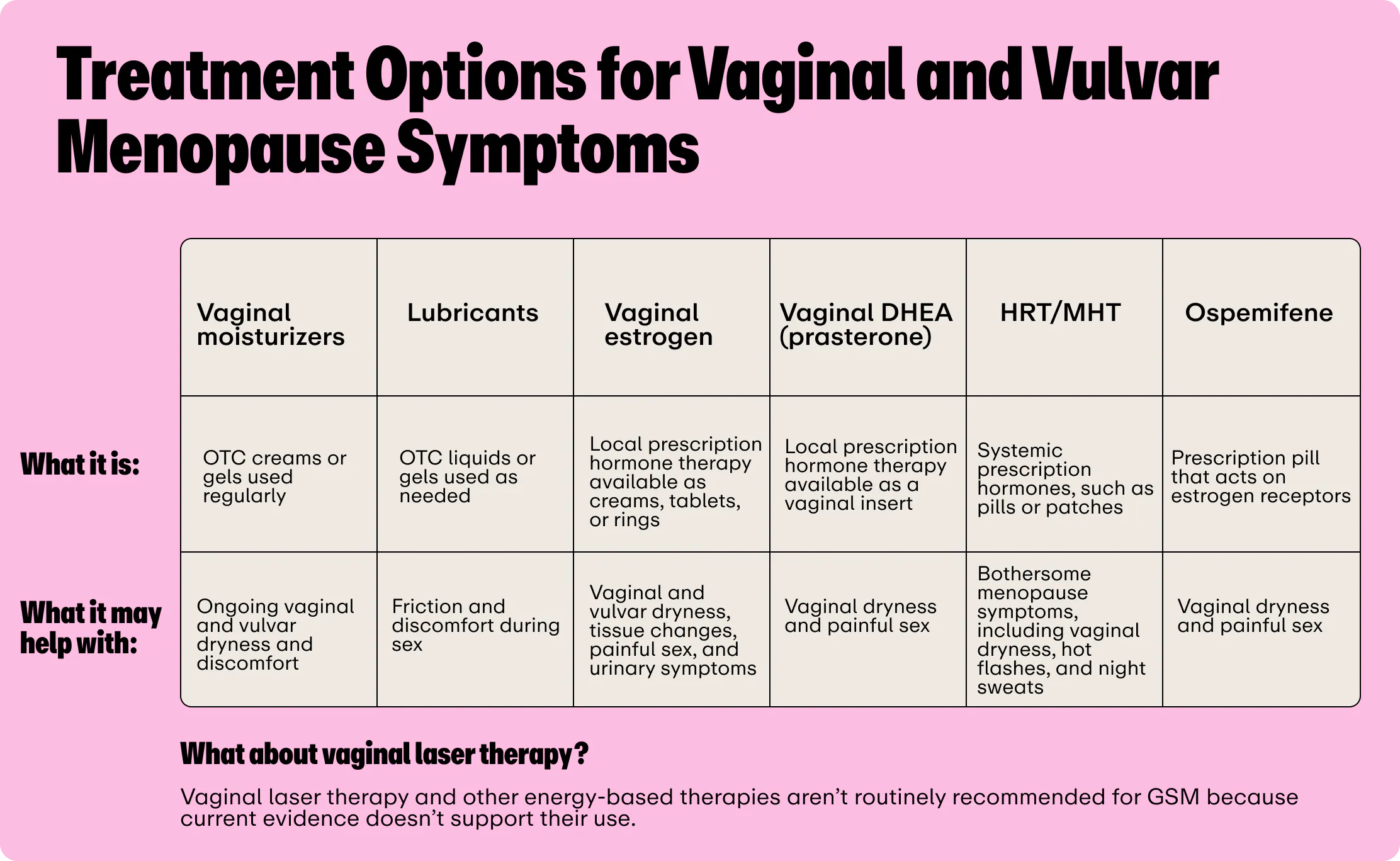
Moisturizers
Vaginal moisturizers, which include brands such as Revaree and Replens, work slightly differently than lubes.
“They are put into the vagina or onto your vulva every 1 to 3 days and adhere to the tissue, meaning that they can offer continuous moisture,” says Dr. Carothers. “It’s similar to applying body moisturizer to the other skin on your body. It keeps the area moist and plump and can be extremely helpful. Often I recommend both lubricants and moisturizers to patients who are sexually active.”
Lubricants
Think: products like Astroglide or Sliquid. These over-the-counter (OTC) lubricants can be used on the vulva, vagina, and penis to add temporary moisture and reduce the painful effects of friction.
Vaginal estrogen
This is a prescription medication that can help make your vaginal and vulvar tissues plumper, more moisturized, and less sensitive. Vaginal estrogen also helps with urinary symptoms and can reduce recurrent UTIs. It comes in various forms, including creams, tablets, and vaginal rings.
“And because vaginal estrogen works at the point of application—and isn’t absorbed into your bloodstream—it can be used in conjunction with hormone replacement therapy and OTC treatments like lubricants,” says Dr. Carothers. “It’s even safe for women with a history of breast cancer.”
Hormone therapy
Hormone replacement therapy (HRT, now commonly referred to as menopause hormone therapy, or MHT) is commonly prescribed to help relieve vaginal and vulvar dryness and other menopause symptoms. It’s the most effective treatment for hot flashes and night sweats but may also help with related symptoms like brain fog and mood changes. It’s worth having a conversation with your healthcare professional to see whether you could be a good candidate for HRT.
Vaginal DHEA (prasterone)
Vaginal DHEA (prasterone) is a prescription insert that’s typically used once per day. Once inside the vagina, DHEA is converted into estrogens and androgens that keep vaginal tissue healthy. This can help reduce vaginal dryness and relieve pain during sex caused by GSM.
In fact, the first comprehensive guidelines on GSM recommend vaginal DHEA as a treatment option for these symptoms. The American Urological Association (AUA) released the guidelines in 2025, with endorsements from The Menopause Society and the International Society for the Study of Women’s Sexual Health.
Midi's DHEA / Estradiol Cream is another local prescription treatment designed to rejuvenate the vulvar tissues and support libido.
Ospemifene
This oral medication might be prescribed under the brand name Osphena. It isn’t estrogen, but it acts on estrogen receptors in vaginal tissue to help improve GSM symptoms like vaginal dryness and pain during sex. The AUA guidelines recommend it as an option for people who can’t or don’t want to use vaginal treatments.
What about vaginal laser therapy?
Vaginal laser therapy and other energy-based therapies aren’t currently recommended as treatments for GSM. These devices aren’t FDA-approved for GSM, and the 2025 AUA guidelines recommend against the routine use of CO2 laser, Er:YAG laser, and radiofrequency because current evidence doesn’t support these treatments.
What the 2025 Guidelines Changed About Treating Vulvar and Vaginal Symptoms
You may have noticed that the conversation about menopause treatment has shifted recently, particularly around the use of HRT.
In November 2025, the FDA announced plans to remove certain risk statements from menopause hormone therapy products, including low-dose vaginal estrogen. The labeling changes, which removed boxed warnings about cardiovascular disease, breast cancer, and probable dementia, were approved in February 2026. The FDA said these warnings did not accurately reflect current evidence about the risks of these treatments.
A number of leading organizations supported this change, including the American College of Obstetricians and Gynecologists, The Menopause Society, and the AUA. The Menopause Society emphasized that low-dose vaginal estrogen is a safe and effective treatment for GSM.
The boxed warning may have previously deterred women from using hormone therapies, research has suggested, and experts said its removal could increase access to effective treatments that improve menopause symptoms and quality of life. That matters, because about half of women with GSM have never discussed their symptoms with a clinician, let alone received treatment.
It’s important to keep in mind that systemic forms of hormone therapy—such as oral estrogen pills, which circulate throughout the body—still carry certain risks that you should discuss with your clinician.
When Labia Changes Aren’t Menopause: What Else to Rule Out
While menopause can cause sore labia, shifting hormones aren’t the only reason you might experience pain or other labia changes. Other health concerns can cause symptoms that are similar to GSM, which is why it’s important to check in with your clinician about new or bothersome symptoms, rather than assuming they’re part of menopause.
Here are some other possible causes that mean it’s time to check in with a clinician.
- Lichen sclerosus: This inflammatory skin disorder is sometimes mistaken for vaginal atrophy during perimenopause and after menopause. Lichen sclerosus may cause itchy white patches around the vulva and thinning or shrinking labia. It’s more likely to affect postmenopausal women, and it can’t be treated by moisturizers or lubricants. The condition can lead to scarring and painful sex over time, so getting an accurate diagnosis is important. Treatment typically involves a prescription steroid ointment.
- Labial fusion or adhesions: Thin, fragile vulvar tissues can stick together, particularly when low estrogen is combined with irritation or inflammation. Lubricants can reduce dryness and friction but won’t reverse tissue that has fused.
- Vulvar dermatitis: With this condition, you may notice inflamed, itchy, burning, or irritated skin around your vulva. Irritants or allergens—such as certain soaps, douches, or underwear made from synthetic materials—may trigger vulvar dermatitis.
- Vulvodynia: This persistent vulvar pain may feel like burning, stinging, irritation, or soreness, without an obvious cause.
When to Consult a Healthcare Professional
Any symptoms that bother you or affect your quality of life warrant reaching out to your clinician—full stop.
Maybe your labia minora seem different during the menopause transition, or you’ve noticed other changes in how your vulva looks or feels. Maybe sex has become painful after menopause, or you have dryness, burning, itching, or recurrent UTIs. Perhaps you’ve tried lubes and moisturizers and still haven’t gotten the relief you need. Or you want to explore vaginal estrogen or HRT.
Remember that you have options, so you don’t have to ignore these changes. You can work with a clinician—like the ones at Midi, who specialize in women’s health and menopause care—to get the relief you need. They can help figure out what's causing your symptoms and recommend treatments that work for you.
Proactive Tips for Maintaining Vaginal Health During Menopause
Your vulva changes with age, but you can take steps to support your vaginal health and minimize discomfort. In addition to OTC and prescription treatments, you can try several lifestyle changes to help manage GSM symptoms, such as:
- Use gentle, fragrance-free skin care products: When you hop in the shower or bath, avoid any harsh products that can irritate your skin and dry it out more. Choose gentle, fragrance-free products for the vulvar area.
- Do pelvic floor exercises: Yup, we’re talking Kegels. These simple exercises may help support pelvic floor function and improve blood flow to the genitals.
- Stay hydrated: The human body is mostly water, so it makes sense that getting enough H2O helps keep your tissues moist and healthy.
- Have fun: OK, this might seem totally counterintuitive (and a total no-go!) if menopause is making intercourse—or any kind of vaginal stimulation—painful for you. But you can explore new sexual practices to enhance your pleasure and avoid anything that hurts. Talk with your healthcare professional about lubricants that can help and other ways to ease back into it.
Maintaining a Healthy Sex Life
If you wonder whether you can keep the intimacy and pleasure in your relationship going once you hit midlife, the answer experts will give you is: heck yeah.
Dr. Carothers says it starts with good communication—with your partner and a healthcare professional. Talk with your clinician about your symptoms and concerns about how menopause may be affecting your sex life.
That’s especially important because painful sex during midlife can have multiple causes, including:
- Vaginal atrophy, dryness, and irritation: HRT and vaginal estrogen are prescription options that can help improve vaginal tissue health and make intercourse the comfortable, enjoyable experience it should be. “Often women begin to feel like sex is a chore that they have to endure through the pain. Treatments like these can bring the pleasure back,” says Dr. Carothers. Lubes and vaginal moisturizers can help, as well.
- More frequent tearing and fissures: Because the vaginal and vulvar tissues can become delicate during midlife, you might find that penetrative sex causes small tears and fissures more easily. You don’t simply have to endure the pain—your clinician can recommend treatments, like vaginal estrogen and lubricants, to improve tissue health, reduce friction, and help prevent repeat tearing.
- Clitoral changes: The clitoris can also undergo changes during menopause, including atrophy and less sensation, which can make it harder to orgasm. Some women may also develop clitoral phimosis, when the clitoral hood becomes stuck to the clitoris and can’t fully retract. If these changes cause pain or affect sexual function, talk with your clinician about treatment options.
- Underlying conditions: Your clinician can also check whether any other conditions, such as endometriosis, uterine fibroids, or pelvic floor dysfunction, are contributing to the pain you feel during sex.
It’s also important to share your symptoms and desires with your partner. Then the two of you can find ways to make sex better for both of you. For example, you could try different positions or play around with different lubes and vaginal moisturizers. Having an open dialogue can also deepen your partner’s understanding of what you’re going through—and reassure them that changes in your sex life aren’t about them.
Menopause-related symptoms can be treated and managed, so you can boost your libido and reclaim the intimacy in your relationship.
Key Takeaways
- Labia minora changes are common during the transition from perimenopause to menopause, thanks to shifting hormone levels.
- The labia minora can become paler, thinner, smaller, and more delicate during perimenopause and menopause. These changes are part of genitourinary syndrome of menopause (GSM), which affects the vulva, vagina, and urinary tract.
- These tissue changes can also lead to GSM symptoms like dryness, itching, burning, painful sex, urinary symptoms, and recurrent UTIs. Unlike some other menopause symptoms, GSM can get worse without treatment.
- Treatments like vaginal moisturizers, lubricants, vaginal estrogen, HRT, vaginal DHEA, and ospemifene can help relieve bothersome symptoms.
- Not every change to your labia is caused by menopause. Conditions like lichen sclerosus, labial adhesions, vulvar dermatitis, and vulvodynia can cause similar symptoms, so talk with your clinician about anything new or bothersome.
Frequently Asked Questions (FAQs)
Does your labia minora disappear at menopause?
It’s not uncommon for your labia minora to get smaller during menopause—to the point where they may become difficult to see. This can happen as estrogen levels drop during midlife, causing vulvar and vaginal tissues to thin and shrink.
What does a menopausal labia look like?
Menopause can make your labia appear paler, smaller, or less plump. Not all women have noticeable changes like these—but if you do, know that they can be a normal part of menopause as estrogen levels decline. Still, it’s worth discussing new or bothersome changes with your clinician.
Why is my labia minora hanging out?
It’s completely normal for the labia minora to extend beyond the labia majora (outer lips), regardless of where you are in the menopause transition. Labia naturally vary widely in size, shape, and symmetry.
Does menopause change your labia?
Yes, it can. Declining estrogen can make the labia minora paler, thinner, smaller, drier, and more delicate. You might notice any combination of these changes, along with symptoms like itching, burning, or painful sex. Talk with your clinician if these changes bother you, so you can find the right treatment for your symptoms.
Can menopause cause sore labia?
Yes, labia soreness may be a symptom of GSM, which can occur during perimenopause and menopause as the body produces less estrogen. But sore or itchy labia can also have other possible, so check in with your clinician to rule out an infection or inflammatory skin condition.
At what age do your labia shrink?
There’s no specific age, but labia changes can start during perimenopause and become more noticeable after menopause. There’s a ton of individual variation. One study found that 19% of women ages 40 to 45 had vaginal atrophy, compared with 54% of women ages 52 to 55.
Can vaginal estrogen make the labia minora grow back?
The labia minora may not fully return to their premenopausal size or appearance, but vaginal estrogen can improve tissue health, elasticity, and comfort.
Is it normal for one labia to be bigger than the other after menopause?
Yes, labia can range in size and may be asymmetrical, which is normal regardless of whether you’ve reached menopause. But if you notice a new or significant change on just one side, check in with your clinician.
How do you tell menopause changes from lichen sclerosus?
Lichen sclerosus is a chronic inflammatory skin condition that can cause very itchy, sore skin around the vulva. It can be hard to tell the difference between lichen sclerosus and GSM, which can also cause your vulva and vagina to feel itchy and painful, so see your clinician for an exam and accurate diagnosis.
If you’re in perimenopause or menopause and want guidance from clinicians who specialize in women’s midlife health, book a virtual visit with Midi today.
Hormonal change is at the root of dozens of symptoms women experience in the years before and after their period stops.
Our trained menopause specialists can help you connect the dots to guide you towards safe, effective solutions.
Whether you need personalized guidance or a prescription routine to tackle symptoms—including vaginal dryness and irritation, brain fog, hot flashes, sleep trouble, mood swings, and weight gain—we’ve got you covered.
Midi’s mission is to revolutionize healthcare for women at midlife, wherever they live and whatever their health story. We believe that starts with education, to help all of us understand our always-changing bodies and health needs. Our core values guide everything we do, including standards that ensure the quality and trustworthiness of our content and editorial processes. We’re committed to providing information that is up-to-date, accurate, and relies on evidence-based research and peer-reviewed journals. For more details on our editorial process, see here.