


Are vitamin D supplements really that important in midlife? For some women, absolutely. Getting enough vitamin D is important at every age, and especially after menopause, when bone loss speeds up. Vitamin D helps your body absorb calcium to maintain strong bones, supports muscle function, and plays a role in immune health.
The key is figuring out how much vitamin D you actually need. Taking too much can be harmful, so it's important to know what’s right for you. Not sure where to start? A Midi Health clinician can help determine whether you need a supplement, recommend the right dose, and create a personalized plan to support bone strength.
If you’re a midlife woman in the throes of perimenopause or menopause, you may be wondering whether you should take a vitamin D supplement. And honestly? It’s a worthwhile question.
Vitamin D helps your body absorb calcium and maintain strong bones, and supplements can help women who aren't getting enough of this essential nutrient. Plus, as estrogen levels decline during menopause, bone loss speeds up, making it even more important to get enough vitamin D.
But that probably leaves you with more questions. Who actually needs vitamin D supplements, and is D2 or D3 better? How much vitamin D3 per day for a woman is enough? Is it possible to take too much vitamin D? The list goes on.
Below, we’re covering what you need to know about vitamin D supplements, including how much to take, whether you should get your levels tested, and whether pairing vitamin D with calcium or vitamin K2 makes sense.
What Does a Vitamin D Supplement Do?
Vitamin D helps your body absorb calcium and phosphorus, two minerals essential for strong bones. Over time, a vitamin D deficiency can weaken your bones, and your muscles may not function as well. Vitamin D supplements can help fill the gap if you're not getting enough.
Here's a closer look at what vitamin D does:
- Bone health: Vitamin D helps your body absorb the calcium needed to build and maintain strong bones. Getting enough may help prevent osteopenia and osteoporosis.
- Oral health: Vitamin D’s role in calcium absorption also helps keep your teeth—and the bones supporting them—healthy.
- Immune function: The essential nutrient helps regulate your immune system by supporting immune cells that fight bacteria and viruses. It also acts on immune cell receptors to help control inflammation.
- Muscle function: Getting enough vitamin D supports normal muscle function and strength.
- Hair and skin health: Vitamin D helps regulate hair growth and supports cells that keep your skin healthy. Low levels have been linked to certain types of hair loss, but it's unclear whether vitamin D supplements can reverse it.
- Blood sugar and metabolism: Vitamin D may help your body regulate blood sugar and support insulin function. Some studies suggest supplements may lower the risk of type 2 diabetes in people with prediabetes, but more research is needed.
- Mood: Some research suggests that vitamin D supplements may help improve mood, but findings are mixed.
There are three ways to get vitamin D:
- Food: Vitamin D is found in fatty fish like salmon and tuna; egg yolks; and fortified foods such as milk, yogurt, and breakfast cereal.
- Sunlight: Your skin produces vitamin D when exposed to sunlight.
- Supplements: Vitamin D2 or D3 supplements can help fill nutritional gaps.
But getting enough vitamin D from food and sunlight alone isn't always easy. As you get older, your skin becomes less efficient at making vitamin D from sunlight. Certain health conditions, like Crohn's disease, can also make it harder for your body to absorb this nutrient.
For midlife women, adequate vitamin D is an important part of protecting bone health as estrogen levels decline. Along with eating calcium-rich foods and doing regular weight-bearing and strength-training exercises, taking a vitamin D supplement can help if you're not getting enough through food and sunlight.
How Much Vitamin D3 Per Day for a Woman?
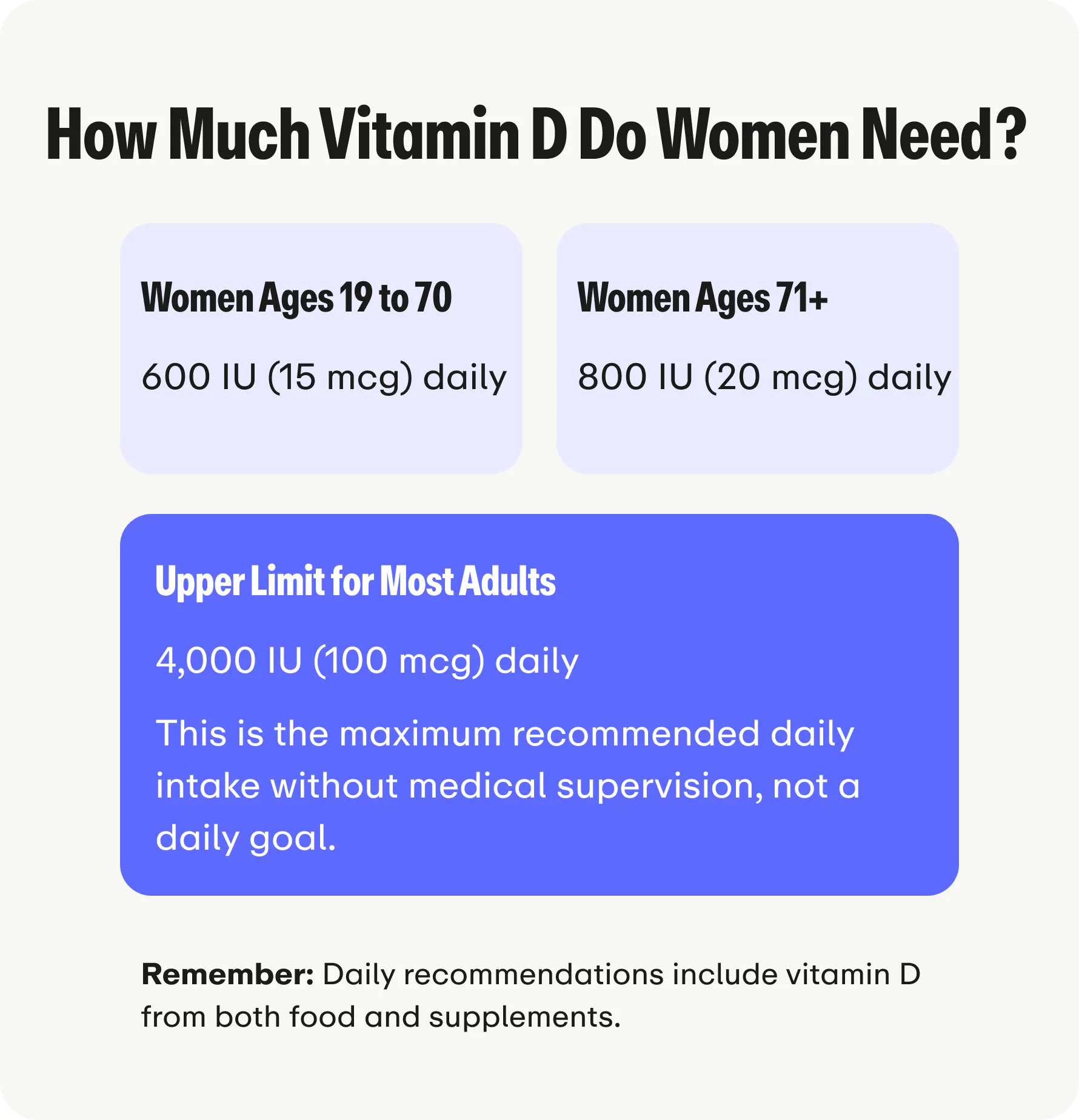
The recommended daily intake of vitamin D for women ages 19 to 70 is 600 international units (IU), or 15 micrograms (mcg). For women over age 70, the recommended amount increases to 800 IU (20 mcg). These recommendations include vitamin D from both food and supplements.
Your needs may differ, depending on your vitamin D level, health conditions, and other risk factors. For example, people with a diagnosed deficiency or conditions that affect nutrient absorption may need higher doses. In some cases, clinicians may recommend a higher dose for a short period, followed by a lower daily dose to maintain healthy vitamin D levels. These treatment plans should always be supervised by a clinician.
Vitamin D supplement labels typically list doses measured in mcg or IU. When shopping for and comparing vitamin D supplements, note that 1 mcg equals 40 IU.
For most adults, 4,000 IU (100 mcg) per day is the upper limit, not a recommended daily dose. Avoid getting more than this amount (from food and supplements combined) unless recommended by a clinician. Too much vitamin D can cause hypercalcemia (high calcium levels in the blood), which can damage your kidneys and lead to other health problems.
Vitamin D2 vs. D3: Which Form Is Better?
Vitamin D2 and D3 are the two main forms of vitamin D found in supplements, but they have a few key differences.
Vitamin D2, also known as ergocalciferol, comes mainly from fungi, such as mushrooms and yeast. Vitamin D3, known as cholecalciferol, is typically derived from animal sources, like lanolin (from sheep's wool), and it’s the same form that your skin produces when exposed to sunlight. Vegan D3 supplements made from lichen are also available.
When it comes to vitamin D2 versus D3, D3 generally has the edge. Research backs this up: A 2024 review of clinical trials found that D3 was more effective than D2 at raising vitamin D levels. Other research suggests that D3 may also help maintain those levels longer.
Both forms can help treat vitamin D deficiency, though, and some prescription-strength supplements contain D2. When choosing a supplement, check the label for the form of vitamin D it contains and the dose per serving.

Who Is Most at Risk of Low Vitamin D?
Low vitamin D levels are common, and many people don't notice any symptoms. When symptoms do happen, they may include fatigue, bone pain, and muscle weakness.
In the United States, more than 1 in 5 people have low vitamin D levels. Some people are more at risk than others, such as:
- Older adults: As you get older, your skin naturally makes less vitamin D from sunlight.
- People with limited sun exposure: This includes people who don’t go outside often, live in areas with less sunlight during winter, or regularly wear clothing that covers most of their skin. Sunscreen can also reduce vitamin D production, although everyday use hasn't consistently been linked to deficiency.
- People with darker skin tones: Melanin (the pigment that gives skin its color) absorbs some of the sun's UVB rays, which can make it harder for the skin to produce vitamin D.
- People with conditions or surgeries that limit fat absorption: This includes people with celiac disease or Crohn's disease, as well as those who have undergone certain types of bariatric surgery.
- People with obesity: Low vitamin D levels are more common in people with obesity, possibly because more of this nutrient is stored in body fat.
- People taking certain medications: Some medications may interfere with vitamin D absorption or metabolism. These include certain antiseizure medications, corticosteroids like prednisone, some statins that lower cholesterol, and the weight loss medication orlistat. Vitamin D supplements can also affect how certain medications work, so tell your clinician or pharmacist about everything you take.
- People with uterine fibroids or PMOS: Low vitamin D levels have been linked to uterine fibroids and are also common in women with polyendocrine metabolic ovarian syndrome (PMOS, formerly known as polycystic ovary syndrome, or PCOS). While it's unclear whether low vitamin D contributes to these conditions, some research suggests supplementation may help improve certain PMOS symptoms.
Several of these risk factors can overlap during midlife. If you're concerned about your vitamin D levels, talk with your clinician about whether testing or supplementation makes sense for you rather than guessing how much to take.
Should You Get Your Vitamin D Level Tested?
The most reliable way to check your vitamin D levels is with a blood test called the 25-hydroxyvitamin D test, also called the 25(OH)D test. But routine testing isn't necessary for everyone. In fact, the Endocrine Society's 2024 guidelines recommend against it for most healthy adults.
Your clinician may recommend testing if you have osteopenia or osteoporosis, a condition that affects vitamin D absorption, or symptoms that could point to a deficiency. Testing may also be helpful if you take certain medications that affect vitamin D levels.
So, what do the results mean? According to the NIH, Vitamin D levels of 20 nanograms per milliliter (ng/mL) or above are considered adequate for most people. Levels below 12 ng/mL are considered too low and could lead to weak bones and other health issues. But some experts use higher cutoffs, so what’s considered an adequate vitamin D level can vary. Levels above 50 ng/mL may be too high and could cause health issues.
If your levels are low, your clinician may recommend a vitamin D supplement and decide whether you need another blood test after a few months to see how well treatment is working.
Vitamin D, Calcium, and K2: Do You Need All Three?
Vitamin D and calcium work together to keep your bones strong. Your body needs vitamin D to absorb calcium, which is why vitamin D and calcium supplements are often recommended together. But that doesn't mean everyone needs to take both or add vitamin K2 to the mix.
Calcium supplements
The recommended daily intake of calcium is 1,000 mg for women ages 19 to 50 and 1,200 mg for women 51 and older. This includes calcium from both food and supplements.
Calcium is essential for bone health, but getting more than you need won't necessarily make your bones stronger. If you're not getting enough from food, a supplement can help make up the difference.
It's generally best to take no more than 500 mg of calcium at a time for better absorption. Taking too much can increase your risk of kidney stones. Research on whether combining calcium and vitamin D supplements prevents fractures is mixed, so the benefits depend on your individual needs.
Vitamin K2 supplements
Vitamin K2 is a form of vitamin K found in fermented foods and some supplements. It helps activate proteins involved in bone health and blood clotting. The recommended daily intake for women is 90 mcg of vitamin K overall, not specifically K2.
There is some evidence that taking a vitamin D and K2 supplement together may offer extra benefits for bone and heart health, but the research is mixed.
This may be especially relevant for midlife women. A 2024 review found that combining vitamins D3 and K2 may improve bone density and cardiovascular health in postmenopausal women, although more research is needed to confirm these effects.
Vitamin K can interact with blood thinners like warfarin, so talk with your clinician before starting a K2 supplement.
Bottom line? You don't necessarily need all three supplements. Your clinician can help you decide what's right for you.
Why Vitamin D Is Part of the Bone-Health Conversation in Menopause
As estrogen levels decline during perimenopause and menopause, bone loss speeds up. In fact, women can up to 20% of their bone density in the first 5 to 7 years after menopause, increasing their risk of osteopenia and osteoporosis. Meanwhile, your skin naturally produces less vitamin D from sunlight as you age.
That's why getting enough vitamin D is especially important during midlife. Vitamin D helps your body absorb calcium to maintain strong bones and supports muscle function, which is important for balance and preventing falls that could lead to fractures.
Low vitamin D has been linked to fatigue and low mood, too. And while some research suggests supplements may help lift your mood, especially if your levels are low, the findings are mixed.
Of course, vitamin D is only one part of staying healthy during menopause. Regular strength training, adequate calcium and protein intake, and hormone therapy when appropriate can also help support bone health.
A menopause-trained Midi clinician can help you decide whether a vitamin D supplement belongs in your personalized Care Plan.

Can You Take Too Much Vitamin D?
Yes, vitamin D is a fat-soluble nutrient that can build up in your body over time. Getting too much vitamin D is almost always caused by taking too much from supplements. Your skin naturally limits how much vitamin D it produces from sunlight, and food alone is unlikely to provide toxic amounts.
Vitamin D levels above 150 ng/mL in the blood are considered very high. Taking excessive amounts of vitamin D over time can lead to toxicity and hypercalcemia (too much calcium in the blood), even if you're not currently taking calcium supplements. This can also cause hypercalciuria (excess calcium in the urine) and kidney stones.
Symptoms of vitamin D toxicity include:
- nausea and vomiting
- constipation
- excessive thirst and dehydration
- frequent urination
- confusion and fatigue
- muscle weakness
- bone pain
- kidney stones
To avoid vitamin D toxicity, most adults should not exceed 4,000 IU daily unless directed by a clinician. That's the upper limit, not a daily goal. Higher doses, including 5,000 IU daily, should only be taken under medical supervision.
How to Choose a Quality Vitamin D Supplement
Vitamin D, like other dietary supplements, isn't FDA approved before it's sold, so it's important to do a little digging to find a high-quality option. The best vitamin D supplement for women is one that fits into your routine and meets your individual needs. Here are a few things to consider:
- Look for third-party testing: Choose supplements with independent testing seals, such as USP or NSF, to help verify quality, purity, and accurate ingredient labeling.
- Choose a format that works for you: Vitamin D supplements come in softgels, tablets, gummies, and liquid drops. Because vitamin D is fat-soluble, taking it with a meal that contains some fat can help your body absorb it.
- Check the dose per serving: Pay close attention to how much vitamin D you're getting, especially if you're taking a multivitamin or other supplements that also contain it. Make sure your total daily intake doesn't exceed the upper limit of 4,000 IU, unless your clinician recommends otherwise.
- Consider vitamin D3 first: It's generally the preferred form, but follow your clinician's guidance if they recommend vitamin D2.
When to Talk With a Clinician About Vitamin D
You can buy a vitamin D supplement over the counter, but it’s a good idea to talk with a clinician before starting one, especially if you're at risk of a deficiency. It may be time to bring it up if:
- You’ve received a diagnosis of osteopenia or osteoporosis, or you’ve had a recent fracture.
- You’re experiencing persistent midlife symptoms like fatigue, muscle weakness, or hair thinning.
- You have a condition that affects nutrient absorption, such as celiac disease, or have undergone bariatric surgery.
- You take medications that can interact with vitamin D, such as thiazide diuretics, steroids, or orlistat.
- Your recent blood work shows that your vitamin D levels are low.
- You're considering a vitamin D supplement but aren't sure how much you need.
When talking with your clinician, be sure to share any supplements or medications you're taking, along with recent vitamin D or bone density test results. You can also ask whether you need testing, what dose is right for you, and whether calcium or K2 supplements make sense.
Want help putting your supplement plan together? A menopause-trained Midi clinician can help you sort through your options and decide on personalized treatment that supports your health through midlife and beyond.
Key Takeaways
- Vitamin D is a fat-soluble vitamin that helps your body absorb calcium and phosphorus to maintain strong bones and support muscle function. Supplements can help if you're not getting enough vitamin D from food and sunlight.
- The recommended daily intake of vitamin D is 600 IU for women ages 19 to 70 and 800 IU for women over 70. Most adults shouldn't exceed 4,000 IU daily unless directed by a clinician.
- You can check your vitamin D levels with a blood test, but routine testing may not be necessary for everyone.
- During perimenopause and menopause, declining estrogen speeds up bone loss, so it’s worth making sure you’re meeting your vitamin D needs, whether through food, sunlight, or a supplement.
- Vitamin D supplements may help women with low levels or conditions that affect nutrient absorption, like celiac disease. A clinician can help you decide whether you need one and recommend an appropriate dose.
Frequently Asked Questions (FAQs)
Is it healthy to take vitamin D daily?
Yes, taking vitamin D daily is generally safe as long as you don't take too much. Vitamin D supplements can be helpful if you're deficient or aren't getting enough from food and sunlight. But not everyone needs one, so talk with your clinician about whether daily supplementation is right for you.
What are the signs of lack of vitamin D?
Some signs of a vitamin D deficiency include fatigue, bone pain, muscle weakness, and sometimes mood changes or hair loss. But many people with low vitamin D levels don't experience any noticeable symptoms.
When is the best time to take vitamin D?
There's no single best time of day to take vitamin D, but taking it with a meal that contains some fat can help your body absorb it better. Try pairing it with foods like eggs, avocado, or yogurt.
What foods have vitamin D?
Foods that contain vitamin D include fatty fish like salmon and tuna; egg yolks; UV-exposed mushrooms; beef liver; and fortified foods like cow’s milk, yogurt, orange juice, and cereals.
What supplement helps absorb vitamin D?
You don't necessarily need another supplement to help absorb vitamin D. Because vitamin D is fat-soluble, taking it with a meal that has some fat can help improve absorption. Magnesium helps your body activate and use vitamin D, but taking extra magnesium isn't necessary for everyone.
If you’re in perimenopause or menopause and want guidance from clinicians who specialize in women’s midlife health, book a virtual visit with Midi today.
Hormonal change is at the root of dozens of symptoms women experience in the years before and after their period stops.
Our trained menopause specialists can help you connect the dots to guide you towards safe, effective solutions.
Whether you need personalized guidance or a prescription routine to tackle symptoms—including brain fog, hot flashes, sleep trouble, mood swings, and weight gain—we’ve got you covered. Learn more here.
Midi’s mission is to revolutionize healthcare for women at midlife, wherever they live and whatever their health story. We believe that starts with education, to help all of us understand our always-changing bodies and health needs. Our core values guide everything we do, including standards that ensure the quality and trustworthiness of our content and editorial processes. We’re committed to providing information that is up-to-date, accurate, and relies on evidence-based research and peer-reviewed journals. For more details on our editorial process, see here.