
 Rebecca Yee, MD

If you’ve recently spotted “FSH hormone” in your lab work or your clinician mentioned testing your FSH levels, you might be wondering what this hormone actually does—and whether high levels mean you’re in menopause. Most women know estrogen 101, but you might not be as familiar with follicle-stimulating hormone (FSH). It plays an important role in the reproductive system by helping eggs develop in your ovaries.
If an FSH blood test suggests your levels are high, that doesn't necessarily mean something's wrong. In fact, rising FSH is a normal part of the menopause transition. Whether your FSH levels are high, low, or somewhere in between, Midi Health’s trained clinicians can help you understand what they mean for your health and talk through any next steps.
You've probably heard plenty about hormones over the years, especially how fluctuating levels affect your periods, fertility, and menopause—but follicle-stimulating hormone (FSH) might not come up nearly as often.
Like estrogen and progesterone, FSH plays an important role in reproductive health. And during perimenopause (the years leading up to menopause), FSH levels begin to rise. This is why you might first hear about FSH if your clinician recommends checking your hormone levels or when reviewing your lab results.
The truth is that getting a complete picture of your hormones during perimenopause and menopause can be a little complex. Levels of FSH, as well as estrogen and progesterone, can rise and fall dramatically from month to month and even day to day, making a single blood test difficult to interpret. Still, an FSH blood test can sometimes provide clues about where you are in the menopause transition.
Changing hormone levels might sound scary, but rising FSH is a normal, expected part of the menopause transition. Below, we'll cover what this hormone actually does in your body, typical FSH levels by age, what high or low results might mean, and when FSH testing may be useful in menopause care.
What Is the FSH Hormone?
FSH is made by the pituitary gland at the base of your brain and plays an important role in your menstrual cycle and reproductive health.
The word “follicle” in the name “follicle-stimulating hormone” might make you think of hair follicles, but your ovaries have them, too. Each of these small, fluid-filled sacs contains an immature egg. FSH helps these ovarian follicles grow and mature to prepare for ovulation every month.
FSH doesn't work alone, though. It's part of a hormone feedback system called the hypothalamic-pituitary-ovarian (HPO) axis. Here's how it works: The hypothalamus, another region at the base of the brain, signals your pituitary gland to release FSH and luteinizing hormone (LH). Both hormones then travel through the bloodstream to the ovaries, where they help keep your menstrual cycle on track. (And, FYI, men have FSH, too—it helps support sperm production.)
As ovarian follicles grow, they produce estrogen. Rising estrogen levels, along with other hormones, then signal your brain to adjust how much FSH and LH it releases. This back-and-forth communication helps regulate your menstrual cycle.
What Does FSH Do in Your Body?
As under-the-radar as FSH is, it plays some pretty major roles in your sexual development and reproductive system. And it all starts with puberty: During this time, your brain signals your pituitary gland to release more FSH and other hormones that stimulate your ovaries. This helps your ovaries produce estrogen, which contributes to changes that eventually lead to your first period.
Speaking of the ovaries, that’s where FSH’s main role comes in. Every month, FSH helps several ovarian follicles develop, with one typically becoming dominant and preparing to release an egg. As the follicles grow, they produce estrogen, which helps prepare the uterine lining for a possible pregnancy. Then, luteinizing hormone (LH), also produced by the pituitary gland, surges around the middle of your menstrual cycle, triggering ovulation (when a mature follicle releases an egg). If sperm fertilizes the egg, pregnancy can occur.
And remember that hormone feedback system we mentioned earlier? Signals between your brain and ovaries help control how much FSH and LH your body releases. That’s why, for example, if you take combined hormonal contraceptives, the estrogen and progestin they contain suppress FSH and LH, typically stopping ovulation to help prevent pregnancy.
FSH and Menopause: Why Levels Rise in Midlife
This hormone feedback system continues, month after month, throughout your reproductive years. But during perimenopause, which usually starts sometime in a woman’s mid-40s, things change. As you approach menopause, you have fewer ovarian follicles, and your ovaries start responding differently to FSH.
Here’s a quick recap of the follicle pool: You're born with all the ovarian follicles you'll ever have, roughly 1 to 2 million. By your first period, that number has dropped to around 300,000 to 400,000. And it keeps naturally declining over time, although the pace varies from person to person.
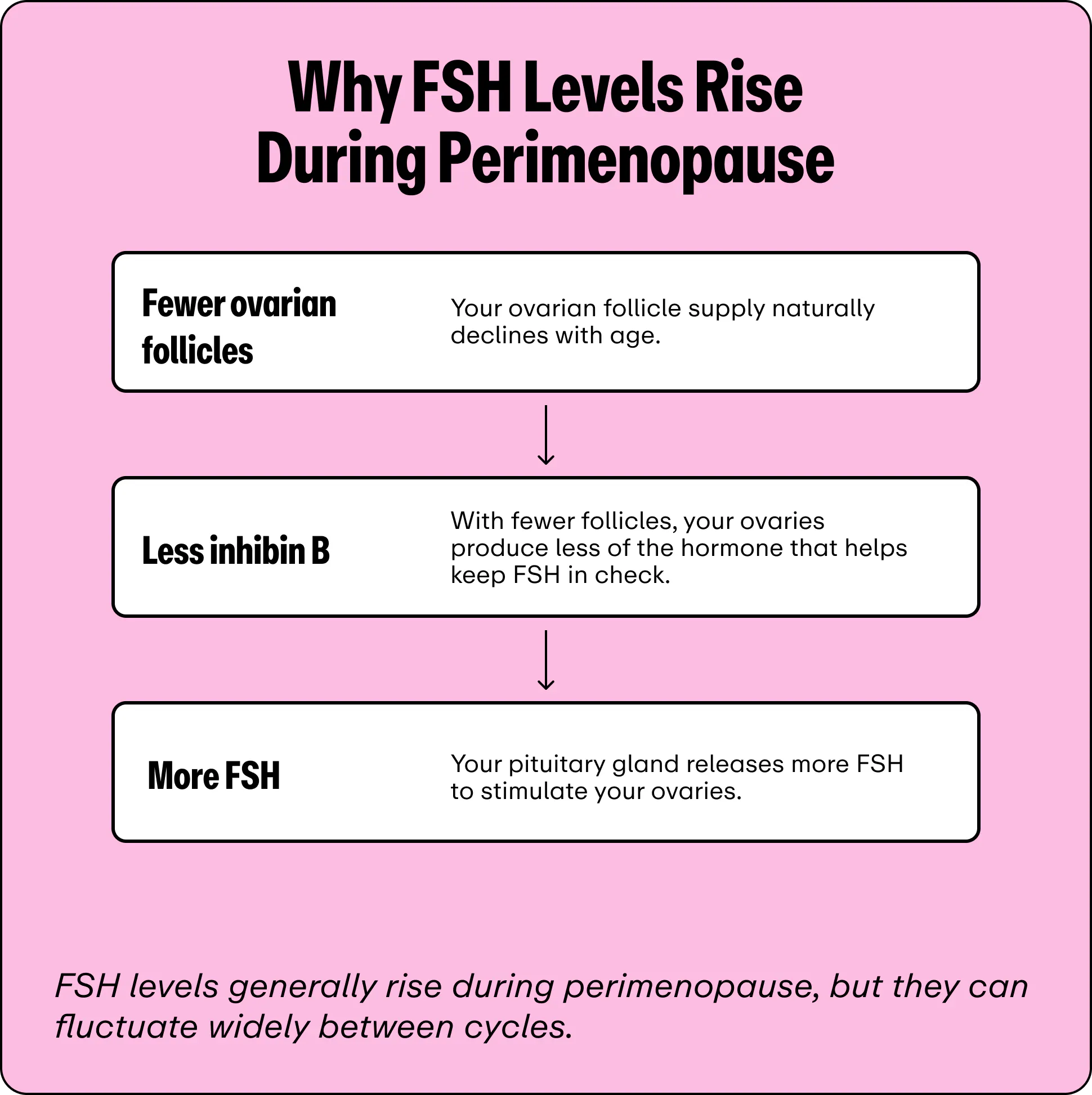
As fewer follicles remain, your ovaries produce less inhibin B, a hormone that helps keep FSH levels in check. Estrogen levels change, too, but during perimenopause, estradiol (the main form of estrogen during your reproductive years) can go up and down quite a bit, rather than steadily declining.
So, how does all this connect to FSH? With less inhibin B and shifting estrogen levels, your brain gets less of its usual “slow down” signal, which changes how the hormonal feedback loop works. In response, the pituitary gland releases more FSH to stimulate the ovaries. This is why FSH levels tend to rise during perimenopause, although they can still fluctuate dramatically from one menstrual cycle to the next.
Meanwhile, rising FSH often goes hand in hand with fluctuating estrogen, which can contribute to menopause symptoms like irregular periods, hot flashes, and disrupted sleep. After menopause, FSH levels generally stay elevated, while estrogen levels remain much lower.
What Are Normal FSH Levels by Age and Stage?
There isn’t one “normal” FSH number because, much like estrogen, follicle-stimulating hormone levels vary, especially during perimenopause. But your clinician can reference typical FSH levels and ranges for different reproductive stages.
Just keep in mind that while an FSH blood test can offer a snapshot of where you are in the menopause transition, it doesn’t tell the full story of what’s happening with your hormones.
Here’s what FSH might look like at the different stages:
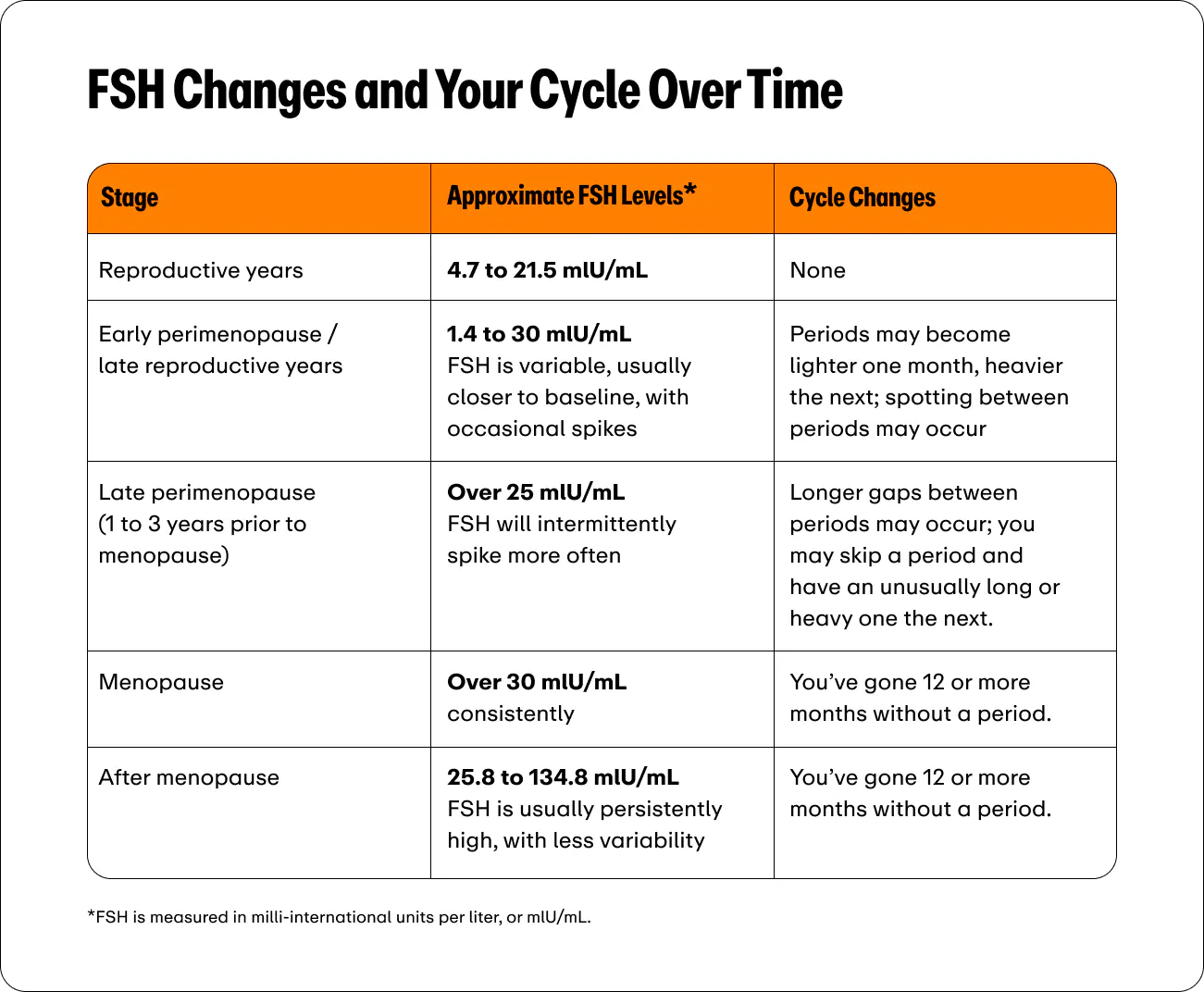
- Premenopausal: FSH levels are typically low, although they rise and fall throughout your menstrual cycle. If you're trying to get pregnant, your clinician may test your FSH levels on day 3 of your cycle as part of a fertility evaluation. This timing isn't generally needed when evaluating perimenopause or menopause.
- Perimenopause: FSH levels can fluctuate, making a single blood test unreliable for determining menopause status. Depending on your age and circumstances, clinicians may use an FSH level above 30 milli-International Units per milliliter (mIU/mL) as a benchmark, but that number alone can't confirm menopause. Hormonal contraception can also affect the results.
- Menopause: Once you've gone 12 consecutive months without a period or any spotting, you've reached menopause. Estradiol levels are generally low, while FSH levels remain elevated, often above 30 mIU/mL.
- Primary ovarian insufficiency (POI): Some women develop POI, which happens when the ovaries stop working normally before age 40. If you've had irregular or missed periods for at least 4 months, an FSH level above 25 mIU/mL may help your clinician diagnose POI. Repeat testing may be recommended if results are unclear.
What Do High FSH Levels Mean?
Consistently high FSH levels generally mean your pituitary gland is releasing more FSH to stimulate your ovaries. During perimenopause, this may reflect declining ovarian reserve, especially if you're also experiencing symptoms like irregular periods, mood shifts, and hot flashes. FSH levels also generally remain elevated after menopause.
There can be other reasons for high FSH, though. One is POI, which, as we touched on above, affects ovarian function before age 40. Certain cancer treatments and surgeries involving the ovaries can also lead to higher FSH levels. Some medications, including those that affect estrogen production or other reproductive hormones, may temporarily raise FSH levels, too.
Remember: A single high FSH reading doesn’t necessarily mean that menopause is right around the corner. Perimenopause can last for years—around 4 on average—and FSH can fluctuate widely throughout that transition. So while high FSH can be a clue that you're approaching menopause, it can't tell you exactly when your final period will happen.

What Do Low FSH Levels Mean?
Low FSH levels mean your pituitary gland is releasing less of the hormone. This isn't necessarily a sign that something is wrong. FSH levels naturally rise and fall throughout your menstrual cycle, and hormonal birth control can also keep them low.
Other things can lower FSH, too, including certain medications, high stress levels, rapid weight loss, or excessive exercise. These can disrupt the signals between your brain and ovaries that help control hormone production.
Less commonly, low FSH may be linked to a problem with your pituitary gland or hypothalamus, which help control hormone production. If your levels are unexpectedly low, your clinician can help determine whether further evaluation is needed based on your symptoms, medical history, and any medications you're taking.
How Does the FSH Blood Test Work?
Getting an FSH blood test requires a standard blood draw. A healthcare professional may recommend checking your FSH levels to evaluate your fertility or help assess whether you're in perimenopause or menopause. (Quick clarification note: Midi clinicians do not currently provide fertility-specific care, but they may check or discuss your FSH levels for menopause-related concerns—more on that in just a bit.)
Timing can matter, depending on why you're being tested. If you’re checking FSH levels to assess fertility, a healthcare professional may recommend having your blood drawn on day 2 or 3 of your menstrual cycle, when levels are easier to compare. But if you're having irregular periods or going months without one, testing may be done on any day.
One important consideration is whether you’re taking hormonal birth control. Combined hormonal contraceptives like the pill, patch, or vaginal ring contain hormones that suppress FSH and can make test results less reliable. A healthcare professional can help determine whether you need to stop taking them before testing and, if so, for how long.
Don't stop taking birth control without discussing your options with your clinician first. You can still get pregnant during perimenopause, so if you stop taking it for testing, you'll need another reliable form of contraception, such as condoms, to prevent pregnancy.
When your results come back, your clinician will review what they mean alongside your symptoms and overall health.
True Stories Of Transformation
Can an FSH Test Confirm Menopause?
No, a single FSH blood test can't reliably confirm perimenopause or menopause. If you’re wondering what FSH level indicates menopause, FSH levels are often above 30 mIU/mL after menopause. But again, no single FSH number can confirm you've reached it. Instead, your clinician will consider your age, symptoms, and menstrual history. Menopause is typically confirmed after 12 consecutive months without a period.
Your hormones fluctuate wildly throughout perimenopause, and a single blood test can be misleading. FSH levels may be high one day and much lower another, even if you're experiencing menopause symptoms. That's why a result that falls within a typical premenopausal range doesn't necessarily rule out perimenopause, either.
Still, your clinician may recommend FSH testing in certain situations, such as when POI is suspected or you've had a hysterectomy or use a hormonal IUD and can't rely on your periods to help track the menopause transition.
The bottom line? Your symptoms and menstrual history usually tell more of the story than a single FSH result. Testing can provide useful clues, but it's just one piece of the puzzle.

When to Talk With a Clinician About Your FSH Levels
Remember, an FSH blood test isn't always a must-have to figure out where you are in the menopause transition. But if you're experiencing symptoms or have concerns about your hormone levels, it's worth talking with your clinician.
FSH testing may be helpful in certain situations, including:
- If you’re under 40 and experiencing symptoms, such as irregular or missed periods, sleep changes, or hot flashes, an FSH test can help your clinician evaluate for POI.
- If you’ve had a hysterectomy or use a hormonal IUD and are experiencing symptoms like brain fog, anxiety, or night sweats, FSH testing may help your clinician assess your menopause status when you can't rely on your menstrual history.
- If you’re taking combined hormonal birth control and need guidance on understanding your menopause status, safely stopping contraception, or transitioning to hormone therapy, your clinician can determine whether FSH testing would be useful. Because combined hormonal birth control suppresses FSH, testing may not be reliable while you're taking it. But if you specifically want to transition from hormonal birth control to hormone therapy, clinicians generally guide this transition based on your symptoms and preferences, rather than requiring lab work.
Support exists at every stage of the transition. Working with a menopause-trained clinician, such as one at Midi, can help you make sense of your lab results, symptoms, and overall hormonal health. Together, you can develop a personalized treatment plan that meets your needs.
Key Takeaways
- Follicle-stimulating hormone (FSH) plays a critical role in reproductive health. Its main job is helping ovarian follicles grow and mature each cycle in preparation for ovulation.
- During perimenopause, FSH levels generally rise as the number of ovarian follicles declines. But FSH can fluctuate significantly from one menstrual cycle to the next.
- Rising FSH levels often coincide with fluctuating estrogen, which can contribute to menopause symptoms like hot flashes, irregular periods, and disrupted sleep.
- Normal FSH levels vary by age and reproductive stage. After menopause, when you’ve gone 12 consecutive months without a period, estrogen levels remain much lower while FSH levels generally stay elevated, often above 30 mIU/mL.
- A single FSH blood test can’t confirm perimenopause or menopause because hormone levels fluctuate throughout the transition. But testing may be useful in certain situations, such as when your clinician suspects primary ovarian insufficiency (POI) or you can't use your menstrual history as a guide.
Frequently Asked Questions (FAQs)
What are normal FSH levels by age?
In general, FSH levels range from 0 to 4 mIU/mL before puberty, less than 1 to 10 mIU/mL during puberty, around 4 to 22 mIU/mL during the reproductive years, and around 25 to 135 mIU/mL after menopause. But FSH levels can fluctuate throughout your menstrual cycle, and a single high result doesn't necessarily mean you've reached menopause.
What happens if your FSH is low?
When you have low FSH, it usually means your pituitary gland is releasing less of the hormone that helps stimulate ovarian follicles to grow and mature. FSH levels can be low if you’re taking hormonal contraceptives or certain medications. Excessive exercise, rapid weight loss, and certain health conditions can also lower FSH levels.
Which FSH level indicates menopause?
After menopause, FSH levels typically stay elevated, often above 30 mIU/mL, while estradiol levels stay low. But no single FSH level can confirm menopause. An FSH blood test only provides a snapshot of your hormone levels, which can fluctuate wildly during perimenopause.
What happens if your FSH levels are high?
If your FSH levels are high, your pituitary gland is releasing more of the hormone to stimulate your ovaries to develop follicles. Though medications and certain health conditions can cause high FSH, it may also point to declining ovarian reserve during perimenopause or the hormonal changes that occur after menopause.
What is a normal FSH level to get pregnant?
There's no single FSH level that guarantees pregnancy. During your reproductive years, FSH levels typically range from 4 to 22 mIU/mL, depending on where you are in your menstrual cycle. Clinicians may check FSH on day 3 of your period to assess ovarian reserve, but the result alone can't predict your chances of getting pregnant.
If you’re in perimenopause or menopause and want guidance from clinicians who specialize in women’s midlife health, book a virtual visit with Midi today.
Hormonal change is at the root of dozens of symptoms women experience in the years before and after their period stops.
Our trained menopause specialists can help you connect the dots to guide you towards safe, effective solutions.
Whether you need personalized guidance or a prescription routine to tackle symptoms—including brain fog, hot flashes, sleep trouble, mood swings, and weight gain—we’ve got you covered. Learn more here.
Midi’s mission is to revolutionize healthcare for women at midlife, wherever they live and whatever their health story. We believe that starts with education, to help all of us understand our always-changing bodies and health needs. Our core values guide everything we do, including standards that ensure the quality and trustworthiness of our content and editorial processes. We’re committed to providing information that is up-to-date, accurate, and relies on evidence-based research and peer-reviewed journals. For more details on our editorial process, see here.