


Your levels of FSH (follicle-stimulating hormone) fluctuate with your menstrual cycle during your reproductive years, but patterns start to shift from the time you enter perimenopause all the way up until you hit menopause—and beyond. An FSH blood test or FSH urine test can tip you off to where you might be in that timeline. The most meaningful and important diagnostic clues are your actual symptoms and cycle changes, of course. But knowing whether your FSH level is within the range of normal and comparing it to an FSH levels chart can raise your hormone IQ and give you a clearer sense of what’s going on. A healthcare professional, like a Midi clinician, can help you understand the whole picture.
In perimenopause, many of your usual hormonal patterns start to shift, kind of like puberty in reverse. Follicle-stimulating hormone (FSH) is one of those hormones that begins to act differently. You won’t feel changes in FSH: Classic perimenopausal symptoms such as hot flashes are related mostly to a drop in estrogen. But those FSH fluctuations can clue you in about where you might be in your hormonal life stage.
The catch? A single FSH number isn’t meaningful on its own—only your symptoms and cycle changes can determine whether you might be in perimenopause or menopause. Plus, the results of a FSH test might be confusing, since the hormone naturally swings up and down.
To clear up the confusion and help you make the most of an FSH test, we’ll explain when it might make sense to do a test, how to interpret the results according to an FSH levels chart, and when to loop in a clinician.
What Is FSH?
Before we get into the actual numbers and what they might mean, it helps know some basics about FSH.
- Follicle stimulating hormone (FSH) is made by your brain’s pituitary gland. And as its name implies, it stimulates the follicles—those small sacs of fluid on your ovaries that house a developing egg—to grow.
- As follicles grow, they secrete estrogen, which matures the egg until it’s released.
- Once estrogen levels climb high enough to release an egg, your pituitary gland senses this and cuts back on FSH, considering it a job well done until the whole cycle starts again.
This changes during perimenopause:
- In your late 30s or early 40s, FSH patterns begin to shift and levels start to rise, marked by erratic dips and spikes. That’s because your body is attempting to compensate for a natural drop in estrogen, which starts to wane around your mid-30s, as follicles age and die off.
- Your pituitary gland continues trying to bump up estrogen by releasing more and more FSH.
- But at the same time, your follicles aren’t capable of producing the amount of estrogen needed to “shut off” FSH. By the time you reach menopause—around age 52 (though it could be earlier or later)—FSH is at an all-time high.
Your FSH level can offer insight about your menopause transition, but it’s certainly not diagnostic. A blood or urine test can reveal what your FSH level is at the time of the test, but a single number won’t tell the full story of your hormonal life. Only your symptoms—such as hot flashes, low libido, and irregular periods—can tip you off about whether you’re in perimenopause, close to menopause, or in menopause. However, an FSH test can provide supportive information and help give you a sense of where you’re at. It’s one piece of the puzzle.
(Fun fact: Men make FSH, too; their FSH, in collaboration with testosterone, signals the testes to make sperm.)
How to Test Your FSH Levels
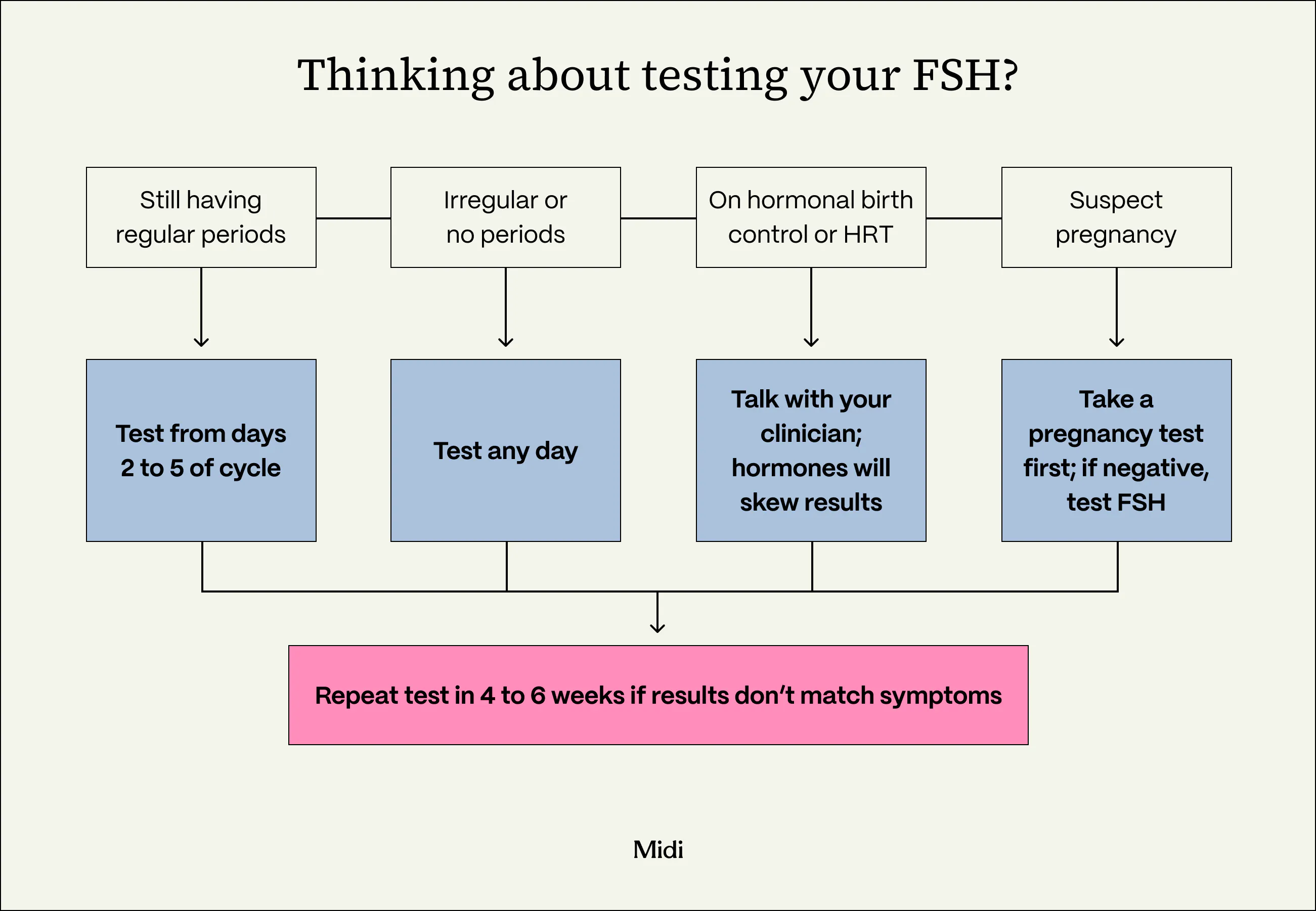
Blood tests are the most reliable way to know your FSH levels. If you’re getting your blood drawn at a lab, your provider can talk you through the steps and timing. Some at-home tests use a pin-prick blood sample that you mail to a lab; other at-home tests use urine and give you results right away.
Some at-home tests also test for luteinizing hormone (LH)—which partners with FSH to trigger ovulation—and estradiol, the main form of estrogen. Here are some guidelines to follow for a lab test or an at-home blood or urine FSH test:
If you are still having regular menstrual cycles
Test on day 2 to 5 of your period to get the most accurate “baseline”—this window is just before follicles begin growing and increasing estrogen, which can affect FSH levels. If you’re repeating the test for several months in a row, be consistent with the day you select. If you’re doing a urine test, use the first morning’s pee, since it will be the least diluted and most reliable.
If your cycles are irregular
In this case or if you’ve stopped having periods—including women who’ve had a hysterectomy—you can draw your blood or test your urine on any day. Experts suggest you do at least 2 FSH tests, separated by a few weeks, to get a better sense of the picture.
If your results are abnormal
This is when your number doesn’t seem to line up with your life stage according to the chart values below. In this case, repeat the test in 4 to 6 weeks. For example, if you believe you are having symptoms of perimenopause but your test says you’re still in your reproductive years, do the test again in several weeks. FSH levels can swing day to day during perimenopause, so one abnormal result doesn’t necessarily mean you’re outside the norm.
When to Hold Off on Doing an FSH Test
You’ll want to delay FSH testing if you check any of these boxes, since these situations will skew the accuracy of test results, making it uninterpretable:
- You are on hormonal contraception: This includes the pill, the hormonal IUD, the patch, or the ring. These methods suppress FSH.
- You’re on hormonal therapy for perimenopausal symptoms: Your FSH will dip as a result of hormonal therapy, so you won’t be able to know your natural status.
- You might be pregnant: If your period is late, and there’s a chance you could be pregnant, take a pregnancy test. FSH drops during pregnancy, so you won’t know what your natural FSH status is. If the test is negative, you can go ahead and test FSH.
What Counts as “Normal” FSH Levels?
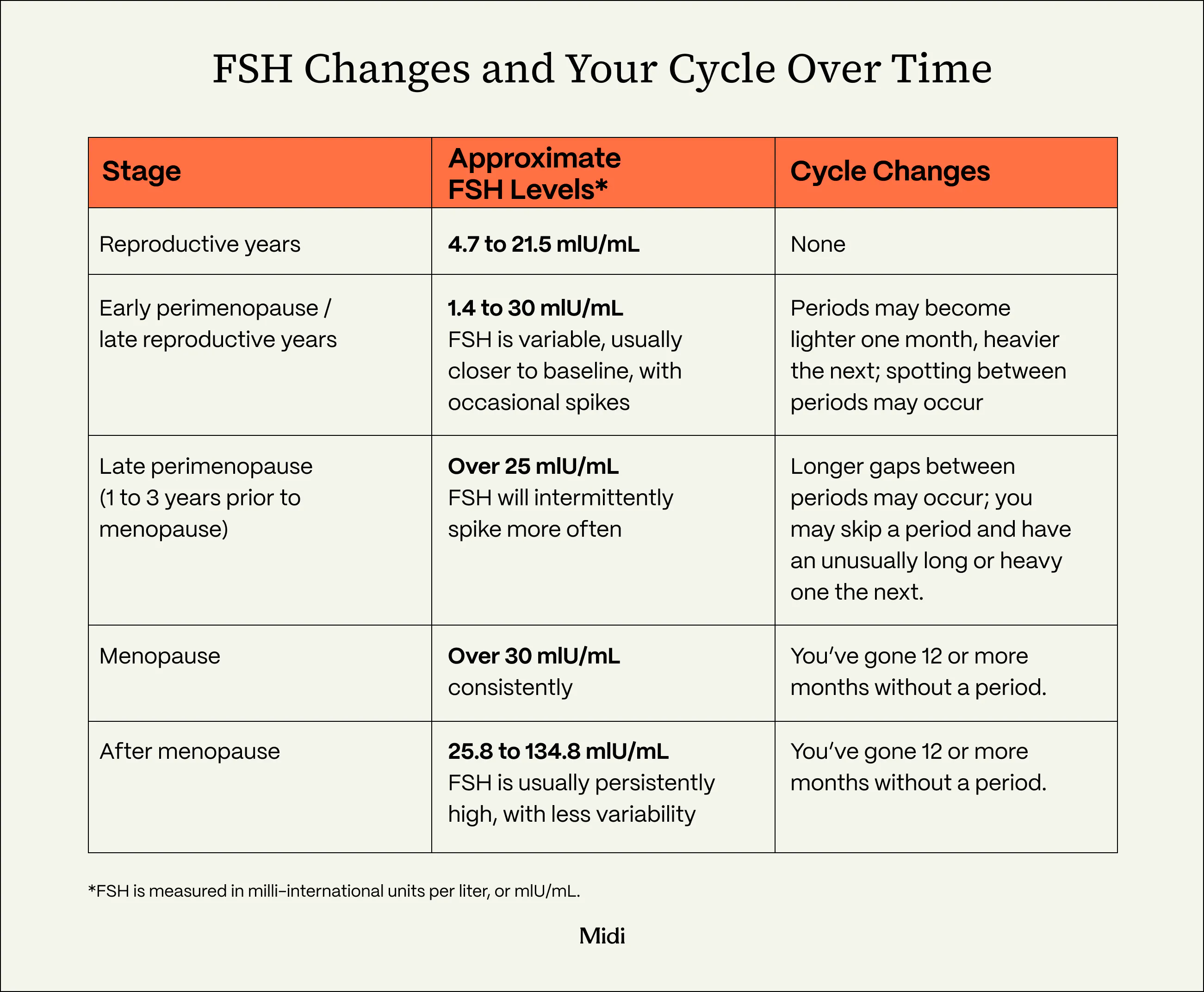
Each laboratory has its own ranges, which may vary slightly. But generally, the ranges in the chart below are the ranges test kits and labs use to determine “normal” FSH results.
Remember, depending on the day as well as your age and stage in life, your FSH can be high, low, or in between. Together with cycle changes and other symptoms, you can begin to get a fuller picture of whether you’re starting perimenopause, in the thick of it, nearing menopause, or in it.
“You’ll get the most accurate result if you check your FSH on two different days, separated by a month or so,” says Amanda Rosales, DNP, APRN, FNP-c, MSCP, Clinical Manager at Midi Health.
What Your FSH Test Results Might Mean
Interpreting your FSH test results is more of an art than a science. That’s because there’s a wide range of normal, and your symptoms are really the truest indicator of your stage. Still, your FSH number can tip you off about where you might be in the timeline and whether you should make an appointment with your provider to discuss any concerns.
Here are some examples of what your results could indicate:
- High FSH with irregular periods → You could be in late perimenopause.
- High FSH with absent periods → You could be approaching menopause or in menopause.
- Low FSH with irregular periods → You could be in early perimenopause.
True Stories Of Transformation
When FSH Levels Could Indicate a Condition or Medical Issue
Most of the time your FSH level is “good to know” rather than “need to know”—in other words, it’s helpful but not diagnostic. However, there are a few situations in which your FSH level could be a sign that you have a condition that needs monitoring or treatment. Most of the time, you’ll also have symptoms of these conditions, so FSH isn’t the only guidepost.
If any of these describe you, plan to follow up with a provider:
- You are under 40 and have repeatedly high FSH levels (above 30 to 40 mIU/mL) →
Ask your doctor about being evaluated for primary ovarian insufficiency (POI). This condition means your follicles are depleted before what’s considered normal for a 40-year-old woman. It can be caused by several things, including a chromosomal abnormality. It’s important to get POI diagnosed as soon as possible, since it can increase the risk of bone loss, heart disease, and endocrine disorders. - You have consistently low FSH levels, especially between days 2 and 5 of your cycle, along with symptoms of tiredness, sensitivity to cold, heavy periods, weight gain and dry skin. →
Ask your doctor about being evaluated for hypothyroidism (when the thyroid gland doesn’t make enough thyroid). This condition is diagnosed by blood tests. - Consistently low or high FSH levels that are outside the normal ranges for your age and stage →
This can also indicate a pituitary tumor or female hypogonadism, which occasionally shows up in women in midlife.
Symptoms vs. FSH Numbers: Which to Prioritize
Regardless of your FSH number, your clinician will prioritize your symptoms over your lab results. If your symptoms are bothersome—if they’re making life tough or uncomfortable or even just annoying. That’s what will lead your provider to discuss treatment options with you.
You do not have to just put up with perimenopausal symptoms. If you’re having trouble sleeping, if anxiety or mood shifts are suddenly a thing, or if vaginal dryness is interfering with your sex life or exercise, you should consider making an appointment with a healthcare professional, such as one at Midi, to learn about treatment options.
Same goes for your menstrual cycle—if heavy or irregular periods are becoming at all concerning, make an appointment. Your FSH level is not the barometer of whether or not you need care. How you feel is.

Safety First: When to Seek Immediate Care
Most of the time, symptoms of perimenopause and menopause are not dangerous and don’t require urgent action. However, if you experience any of these symptoms, call your provider right away:
- Heavy bleeding: Soaking through one pad or tampon per hour, for 2 or more hours or passing large clots (the size of a quarter or larger) can be a sign of hormonal imbalances, such as fibroids, adenomyosis, PCOS, or (more rarely) a precancerous or cancerous condition.
- Dizziness or fainting along with heavy bleeding: This can indicate you’re losing too much blood and are at risk of being anemic.
- Bleeding after menopause: If you’ve gone 12 months without a period and suddenly experience bleeding, it could be a sign of uterine polyps, endometrial hyperplasia (when the endometrium thickens) or, more rarely, cancer.
- Bleeding after sex: It’s not unusual to have bleeding or spotting after sex in midlife—the dip in estrogen can lead to tissue thinning, and friction can break fragile skin. However, it should always be checked out, since there’s a chance it could indicate a polyp or, more rarely, endometrial cancer.
- Severe pelvic pain, fever, or foul discharge: These can be signs of a sexually transmitted infection or pelvic inflammatory disease.
- Persistent premenopausal symptoms before age 40 or having had no period for 3 or more months if you’re younger than 45 without an obvious cause. It’s not uncommon to begin perimenopause in your late 30s, but being early-on-arrival could also signal primary ovarian insufficiency (POI), when the ovaries stop working earlier than average. POI can cause infertility and may be related to autoimmune conditions.
Next Steps With Your Clinician
It’s a good idea to track your symptoms and cycle patterns and bring this log with you, along with a list of all the medications (including hormones) and supplements you’re taking.
Ask a healthcare professional whether you should repeat your FSH test and if it makes sense to measure your levels of estradiol, TSH (thyroid stimulating hormone), the hormone prolactin (high levels can suppress FSH and estrogen and affect your cycles), or iron (women in perimenopause with heavy bleeding can become anemic). Adding these to the mix can help your doctor determine whether there’s anything else going on.
Depending on your symptoms, ask your clinician whether you could benefit from non-hormonal options for relief or hormone replacement therapy (HRT).
If your bleeding is abnormal, be sure to discuss this with your provider, who may suggest a pelvic ultrasound to help determine the cause of the bleeding (fibroids or polyps, for example).
Finally, don’t rule out a discussion about contraception if you’re still sexually active and not yet in menopause. Until you have 12 months without a period, there’s still a chance you could become pregnant. Unlikely? Yes. Impossible? No.

Key Takeaways
- Follicle-stimulating hormone (FSH hormone) levels naturally fluctuate and rise during perimenopause and menopause as the brain attempts to compensate for declining estrogen.
- Consulting an FSH levels menopause chart provides insight into your hormonal life stage, as normal FSH levels in women generally jump from under 21.5 mIU/mL during reproductive years to consistently over 30 mIU/mL in menopause.
- An FSH blood test or at-home urine test offers a helpful snapshot of your hormone status, but because levels spike and dip during perimenopause, a single reading cannot diagnose menopause on its own.
- Healthcare clinicians prioritize your physical perimenopause symptoms and menstrual cycle changes over specific lab results when diagnosing your transition and determining the best treatment options.
Frequently Asked Questions (FAQs)
What is a normal FSH level in menopause?
While it’s not a one-size-fits-all thing, generally a normal range once you’re in menopause is 25.8 to 134.8 mlU/mL, with a trend upward over time and consistently higher numbers. But the only way to know for sure you’re in menopause is if you go at least 12 months without a menstrual cycle.
How do you interpret FSH levels?
Comparing your level to the range of normal levels at various stages—reproductive years, early perimenopause, late perimenopause and menopause—can help you understand where you might be in your transition. FSH levels on their own aren’t diagnostic, however, and must be interpreted alongside your symptoms and your cycle changes.
What is the FSH cut-off for menopause?
There’s no single cut-off for menopause. Consistent results above 30 mlU/mL, along with not having had a period for 12 months or longer, indicates you’re in menopause.
What FSH is too high?
“Too high” depends on several things, including your age and stage. Most of the time, high levels are nothing to be concerned about, since FSH can swing pretty high. But if you’re under age 40 and have FSH that’s above 30 to 40 mIU/mL, it could indicate you have primary ovarian insufficiency (POI), an issue with your pituitary gland, or another condition that needs to be ruled in or out.
If you’re in perimenopause or menopause and want guidance from clinicians who specialize in women’s midlife health, book a virtual visit with Midi today.
Hormonal change is at the root of dozens of symptoms women experience in the years before and after their period stops.
Our trained menopause specialists can help you connect the dots to guide you towards safe, effective solutions.
Whether you need personalized guidance or a prescription routine to tackle symptoms—including brain fog, hot flashes, sleep trouble, mood swings, and weight gain—we’ve got you covered. Learn more here.
Midi’s mission is to revolutionize healthcare for women at midlife, wherever they live and whatever their health story. We believe that starts with education, to help all of us understand our always-changing bodies and health needs. Our core values guide everything we do, including standards that ensure the quality and trustworthiness of our content and editorial processes. We’re committed to providing information that is up-to-date, accurate, and relies on evidence-based research and peer-reviewed journals. For more details on our editorial process, see here.


