 Claudia Levine, MD
 Amanda Alvelo-Malina, MD
Walking with a weighted vest is one of those fitness trends you see everywhere—suddenly your neighbor, your book club friend, and that impossibly fit person at the farmers market are all rocking one. The good news? A weighted vest can have real benefits, including stronger muscles, better bone density, and more intense workouts, especially as bone health issues become more prevalent during menopause. The catch: You need to use a weighted vest smartly. Make sure it fits properly, add weight gradually, and pay attention to how you feel afterward. Here, we'll walk you through what you should know.
Going on a walk is the classic advice for getting more active and improving your health. But just walking isn’t trendy enough anymore—now you need to do it wearing a weighted vest. These vests used to be the domain of ultra-athletes doing intense training, but now they are everywhere: on moms at school pickup, groups of friends hitting the hiking trails, and probably someone’s fitness influencer cousin.
The idea behind it makes a lot of sense: Strap on a weighted vest, which can usually be adjusted up to 20 pounds or more, and you’ve added an external load to whatever activity you’re doing. This amps up the intensity and forces your body to put more effort into moving.
But it’s easy to get caught up in the promises and forget to make sure you’re using the vest in a healthy way. Here’s how to figure out whether a weighted vest is right for you, tips for choosing one, and strategies for working it into your workout routine safely.
Why Consider a Weighted Vest (Big Wins)
On the fence about adding a weighted vest to your workouts? Here are some of the reasons you might want to:
- Maintain bone density: Putting stress on your bones can help you avoid losing bone density. While strength training is the best bet for actually building bone density, walking with a weighted vest can help maintain what you have. While research is still ongoing to figure out exactly how much extra benefit you get with a weighted vest, many experts think it’s logical that walking with a heavier weight will increase the benefits—and do it in a low-impact way.
- Stronger muscles: If your legs are used to hauling 160 lb around and all of a sudden they’re carrying 180 lb thanks to a weighted vest, your muscles are going to have to work harder with every step.
- Cardio and metabolic bump: Adding more weight makes your workout more challenging, so your heart and lungs are going to pick up the pace. It’s similar to how walking uphill is harder than walking on a flat surface. This means you could burn more calories walking the same distance.
Benefits of Walking with a Weighted Vest
This all sounds great in theory, but is a weighted vest actually right for your life? It might be if you fit into one of these categories:
- You’re in perimenopause or menopause: The drop in estrogen during this time causes you to lose bone density and can make you gain weight, especially around your midsection (aka, "meno belly"). Boosting the intensity of your aerobic activity and putting more stress on your bones while walking can help with both of these things.
- You have a busy schedule: Want more bang for your workout buck? You can either add more time or add more intensity. A weighted vest lets you pick door number two, so your 20- or 30-minute neighborhood loop accomplishes more without eating into your schedule.
- You’re looking for a joint-friendly workout: High-impact moves like jumping and running are good for your bones but maybe not so much for your joints. With a weighted vest, you can stick with the low-impact activity you love—walking—but get some of the health benefits of high-impact activities.
- You want to boost your stamina: Maybe you’ve got a big trek coming up, like going on a multiday hike or hoping to climb the stairs in the Eiffel Tower. Adding a weighted vest to your workouts can help build that endurance in a gradual way.
Who Should Be Cautious (Safety First)
Even if it sounds like a weighted vest is a great fit for your health goals and personal needs, some people should pump the brakes. Talk with your doctor before trying a weighted vest if you:
- Are pregnant or trying to conceive: Most experts recommend you don’t wear a weighted vest if you’re pregnant, as it can put extra strain on your abdomen, joints, and pelvic floor. Your doctor can recommend other activities for you to stay healthy.
- Have pelvic floor symptoms: Adding weight by wearing a vest can put pressure on your pelvic floor, so you should only use one if you have a strong pelvic floor to begin with. Anyone who has leakage, has pelvic floor prolapse, or has given birth within the last year should check in with a health care provider before wearing a weighted vest.
- Have bone issues, significant back pain, or heart disease: Because weighted vests add strain to your bones and heart, anyone with osteoporosis, a recent fracture, heart issues, or significant pain in their knees, hips, or back should check in with their clinician before adding a weighted vest to their walks.
- Have a history of dizziness, balance issues: If this describes you, no matter what kind of workout you’re doing—weighted vest or not—you’re going to definitely want to go over your plan with your doctor and make sure you’re being safe. They may recommend you work out with the weighted vest in a supervised setting, like with a trainer, or choose another way to make your workouts harder.
How Heavy Should a Weighted Vest Be? (Start Low, Progress Slow)
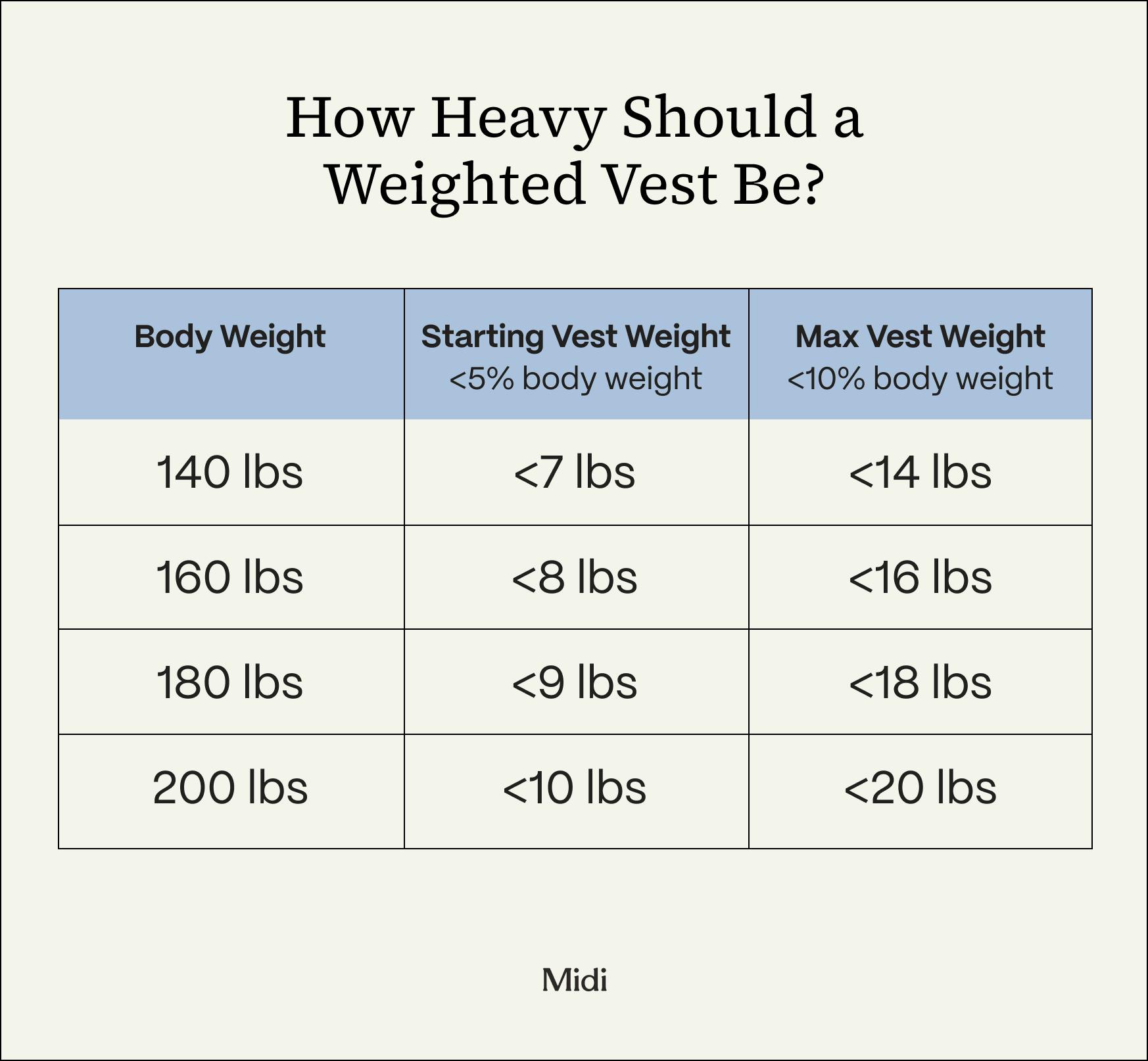
Don’t go full commando and grab the heaviest vest available on day one. Start light, and gradually increase as your body adapts. Begin with a weight that’s less than 5% of your body weight (so if you weigh 180 lb, don’t go over 9 lb to start). If you’re just starting an exercise routine, go even lighter (like 2% of your body weight).
Wear that weight for a few weeks to see how your joints feel and whether you’re able to still carry on a conversation while wearing it. If so, you can start to go up to a heavier weight. But again: Don’t progress too fast. At most, you should be adding 1 to 2 lb per week to the vest, and if you notice your joints, back, or pelvic floor reacting badly to the extra weight, dial it back down.
A general rule of thumb if you’re walking with the vest: Don’t go over 10% of your body weight. That’s 18 lb if you weigh 180 lb. If you are on the fitter end of the spectrum, you can talk with a healthcare professional about going heavier and the right way to do it.
4-Week Weighted Vest Ramp Plan (Walking)
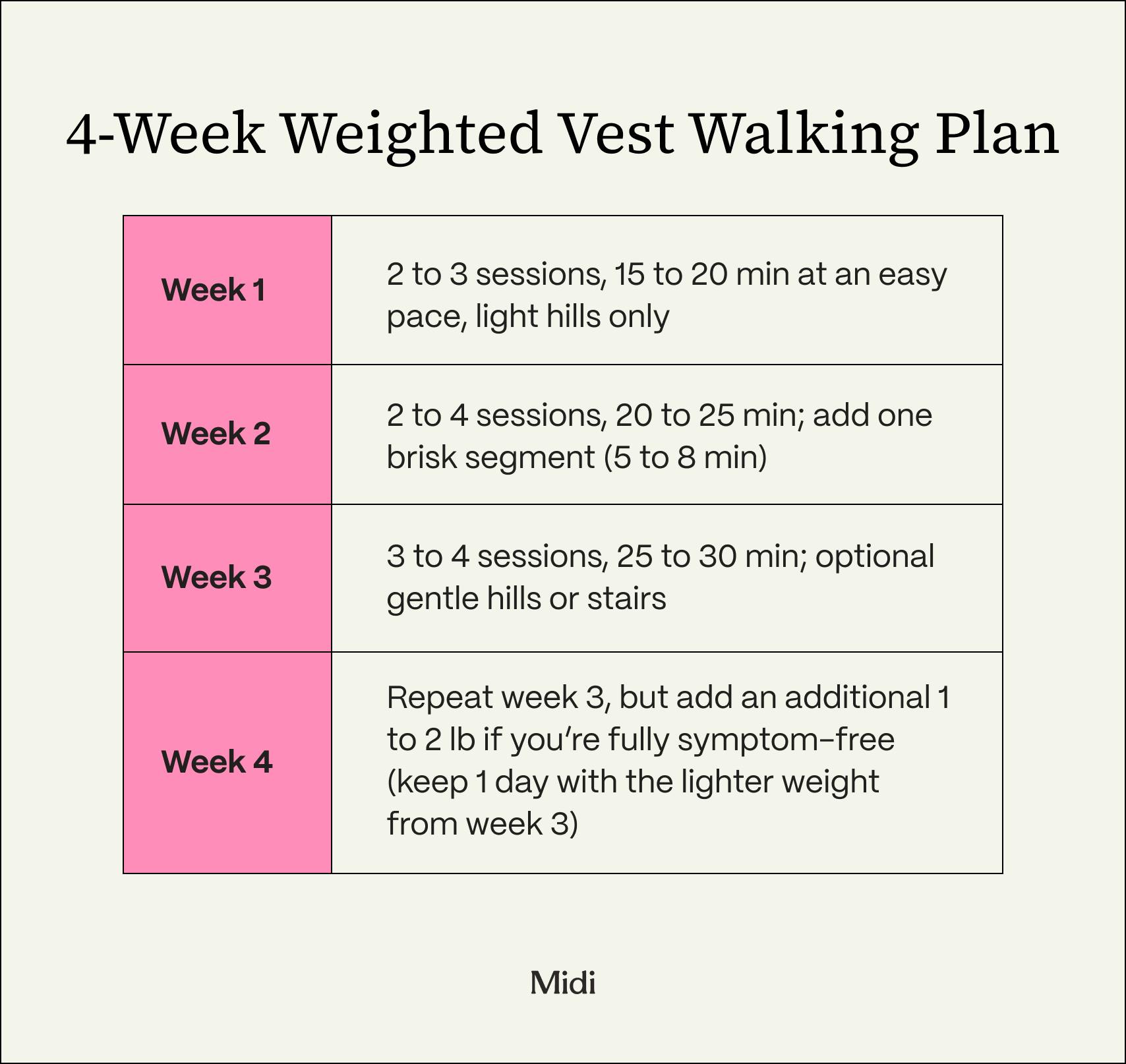
Looking for a schedule to follow that will help you get the benefits of a weighted vest in a safe way? Here’s one to try:
- Week 1: 2 to 3 sessions, 15 to 20 min at an easy pace, light hills only
- Week 2: 2 to 4 sessions, 20 to 25 min; add one brisk segment (5 to 8 min)
- Week 3: 3 to 4 sessions, 25 to 30 min; optional gentle hills or stairs
- Week 4: Repeat week 3, but add an additional 1 to 2 lb if you’re fully symptom-free (keep 1 day with the lighter weight from week 3).
Only progress from each week to the next if your joints are happy, there’s no pelvic leakage or heaviness, you’re able to talk easily while walking, and your sleep is unaffected.
Strength Training with a Vest (Beyond Walking)
Walking gets all the weighted vest glory, but it’s not your only option. You can also use it to make bodyweight moves like squats, step-ups, incline push-ups, and lunges harder. But as you add weight to these moves while wearing a vest, form becomes even more crucial. Make sure you’re doing the moves correctly with a stable core, and stop if you feel any joint pain or pelvic floor symptoms.
Buying Guide (Fit Matters More than Max Weight)
You’ve got a lot of options when it comes to buying a weighted vest, and what you’re really going to want to focus on is fit and customization.
Everyone’s body is a little different, so make sure the vest fits your torso: If you have a shorter torso, you’ll need one with a shorter cut or it will rub your hips uncomfortably. And make sure it’s comfortable around your chest, especially if you're busty.
Trying on the vest is key here. Zip or buckle it on and ask yourself: Can I breathe deeply? Is this thing jabbing my collarbone or hip bones? Then, start to look for extra features:
- Can I adjust the load by adding or taking off weights in 1- or 2-pound increments?
- Does it go up to 20 lb (the maximum weight for most people walking)?
- Are the weights evenly distributed on the vest, both on the front and the back?
- Are the shoulders comfortable and padded?
- Does it feel secure when I strap it on or does it bounce around when I walk briskly?
- Is the fabric breathable, with a washable liner?
- Are there reflective details for when I go on evening walks?
Form and Technique Tips (What to Feel, What to Avoid)
Walking with a weighted vest is pretty similar to walking without one, but you want to be extra mindful of your posture. Stand tall with shoulders back and down, ribs over your pelvis. Let your arms swing naturally at your side, and shorten your stride a bit when you go downhill. About those hills, don’t tackle steep ones right away. Wait until your body is adjusted to wearing a weighted vest first, then get into higher inclines.
A few other tips: Don’t add weights elsewhere on your body, like on your wrists or ankles, and keep your hands free. And one that goes for anyone walking for exercise: Make sure you’re wearing supportive footwear.
Women-Specific Considerations for Weighted Vests
There are a few additional things women need to think about when working out with a weighted vest:
- How’s your pelvic floor doing? Menopause can weaken your pelvic floor muscles, and weighted vests can put additional pressure on your pelvic floor. Keep an eye on how it feels during your walks. If you notice leakage, heaviness, or pressure, reduce the load you’re carrying or shorten your walks (and check in with a healthcare provider to make sure everything is OK).
- Are your breasts being compressed? This is especially important for women with larger breasts who have to wear high-support sports bras. Make sure the vest doesn’t push too hard on your breasts or make them hurt.
- Are hormones impacting things? Whether you’re still dealing with periods and the PMS that accompanies them or have menopause-related sleep and mood issues, make sure you’re physically capable of a higher-effort workout before putting on your vest. If you don’t feel up to it on a given day, it’s fine to lighten your load, walk on flat routes, or leave the vest at home until you feel better.
Troubleshooting
Sometimes things are going great, until they’re not. Check in with a healthcare provider if you experience persistent discomfort or anything concerning to you. Here’s how to handle common weighted vests issues:
- Knee pain: Usually this means you're pushing too hard or progressing too fast. Reduce the weight, pick flatter routes, check that your shoes are still supportive, and do some quad strengthening to better support your knees.
- Low-back tightness: Lightening your load could help with this too, but also make sure your vest isn’t too long in the torso and that you’re engaging your core correctly.
- Neck/shoulder strain: Try moving the weights around into different vest pockets to see if that helps relieve the pressure on your shoulders. Also see if there’s some sort of padding you can add under the vest to cushion the impact.
- Fatigue/poor sleep: The vest might be too heavy for you, causing you to exert yourself too much. Go back to walking with just your body weight for a week, then start adding weight gradually again.
Key Takeaways
- Weighted vest benefits include stronger muscles, a modest boost in bone density support, and higher workout intensity without adding impact.
- Weighted vests can be especially helpful during perimenopause and menopause, when bone density and muscle mass naturally decline. To get the benefits safely, start with a light load (under 5% of body weight) and increase gradually.
- Wearing a weighted vest while walking can increase calorie burn and cardiovascular effort in less time.
Frequently Asked Questions (FAQs)
What does a weighted vest do for you?
A weighted vest can make simple movements, like walking, more intense. By adding weight to your body, it causes your heart, muscles, and lungs to work harder, helping you get more of a workout in the same amount of time.
Do weighted vests help you lose belly fat?
By making your workouts harder, weighted vests can help you burn more calories during your walks. This can help you build muscle and lose overall fat. That said, they are not proven to help you lose belly fat, per se.
What are the negatives of weighted vests?
If you don’t add weight safely or have the right posture while wearing a weighted vest, you may end up straining your back and other joints. And weighted vests can also put pressure on your pelvic floor, leading to issues like leakage.
Is it safe to walk daily with a weighted vest?
As long as your body feels good and you have slowly worked up your time spent walking in a weighted vest, it’s safe to wear it every day. If you start to notice joint pain, reduce how often you wear it.
How long should I wear a weighted vest?
If you’re new to wearing a weighted vest, start with 15 to 20 minutes at a time. Once you get comfortable wearing it, you can up your time by 5 to 10 minutes each week.
If you’re in perimenopause or menopause and want guidance from clinicians who specialize in women’s midlife health, book a virtual visit with Midi today.
Hormonal change is at the root of dozens of symptoms women experience in the years before and after their period stops.
Our trained menopause specialists can help you connect the dots to guide you towards safe, effective solutions.
Whether you need personalized guidance or a prescription routine to tackle symptoms—including brain fog, hot flashes, sleep trouble, mood swings, and weight gain—we’ve got you covered. Learn more here.
Midi’s mission is to revolutionize healthcare for women at midlife, wherever they live and whatever their health story. We believe that starts with education, to help all of us understand our always-changing bodies and health needs. Our core values guide everything we do, including standards that ensure the quality and trustworthiness of our content and editorial processes. We’re committed to providing information that is up-to-date, accurate, and relies on evidence-based research and peer-reviewed journals. For more details on our editorial process, see here.